


The Asian Scientist 100
Di Li

Institution
National Astronomical Observatories of the Chinese Academy of Sciences
Country
China
Field
Aerospace & Astronomy
Li received the Marcel Grossmann Award for his pioneering contributions in the field of fast radio bursts. Li is the first scientist in China to receive this prize for research conducted within China.
(Photo: The Paper)
AWARDS
- Marcel Grossmann Award
Related articles

Healthcare Leaders To Discuss ASEAN Trends
Hospital operators, investors and developers will come together to discuss the latest innovations and strategies at Healthcare World Asia 2014 held at Suntec Singapore Exhibition & Conference Center from 29 Sep to 2 Oct.

Zeroing In On The Proton’s Magnetic Moment
Scientists can now directly measure the magnetic moment of a single proton with high precision, which may enable them to answer why matter exists.

2014 Fifa Ball Has Stable Flight Trajectory
According to scientists from Japan, the Adidas Brazuca owes its expected stable aerodynamic performance to its six-panel design.

Personalized Genetic Test With Gold Nanoprobes
Scientists at IBN have developed a gold nanoparticle-based test that could help patients with blood clots get the correct dose of warfarin faster.

Six Scientists Honored With 2014 Shaw Prize
Six 2014 Shaw Prize winners have been recognized for their contributions to astronomy, life science & medicine and mathematics.

Holmes Appointed President Of Australian Science Academy
The Australian Academy of Science has selected its 18th president, a pioneer in the field of light-emitting polymers, Professor Andrew Holmes.
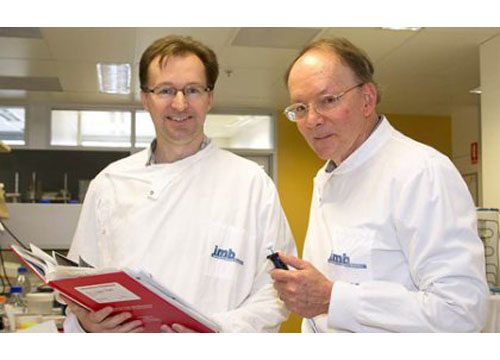
Growth Hormone Receptor Mechanism Unveiled
Scientists now have a mechanistic understanding of how the binding of growth hormone to its receptor causes downstream signaling.

Orb-Web Spiders Masquerade As Bird Poo
Scientists have shown that disrupting the orb-web spider's bird dropping masquerade makes them four times more likely to be attacked by predatory wasps.

Depressed? Get Help At Work!
Evidence-based workplace depression prevention programs greatly reduce depression symptoms, according to scientists from Australia.