


The Asian Scientist 100
Yu Min

Academician
Institution
Chinese Academy of Sciences
Country
China
Field
Physics
Yu was given the 2014 National Highest Science and Technology Award, China’s top science award, for his research into hydrogen bombs.
(Photo: Peking University)
Related articles

MERS Vaccine Unlikely Soon, Experts Say
Due to the difficulty of finding a suitable animal model to study the disease, researchers do not expect a working MERS vaccine within the next few years.

Exercise Helps Mice Escape Side Effects of Epilepsy Drugs
Having access to an exercise wheel seems to protect mice from the negative effects of prenatal exposure to antiepileptic drugs.

EmTech Asia Names 2016 Top Ten Innovators Under 35
Eight researchers and inventors based in Singapore and two from Australia have been selected as this year's finalists for EmTech Asia's top innovators under 35.

More Bacon For Your Buck
Bama mini pigs thrive even on a low protein diet, suggesting that raising indigenous Chinese pigs could reduce feeding costs.

ASLAN & Hyundai Pharm Collaborate To Develop Cancer Drug
The two companies will conduct clinical trials to assess varlitinib in the treatment of aggressive bile duct cancer, a disease prevalent in South Korea.

Four Asian Teams Win 2016 Breakthrough Prize In Fundamental Physics
Established by key entrepreneurs in the Silicon Valley, the 2016 Breakthrough Prize in fundamental physics went to Japanese, Chinese and Canadian research teams working on neutrino oscillation.

Precise, Reversible Control Of Calcium Flux
By combining optogenetics with the Ca2+ sensor STIM1, scientists now have unprecedented control over Ca2+ influx into a cell in vitro and in vivo.
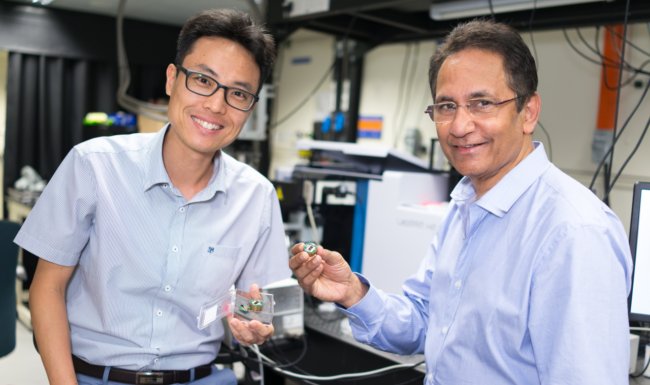
Add Graphene For Super Sensitive Magnetoresistance Sensing
A graphene-based magnetoresistance sensor has proven to be 200 times more sensitive than commercially available ones made of silicon or indium antimonide.

Solving The REM Sleep Mystery
Using genetic tools to manipulate activity of a specific class of neurons in the brain, neuroscientists have identified the neural circuit involved in REM sleep.