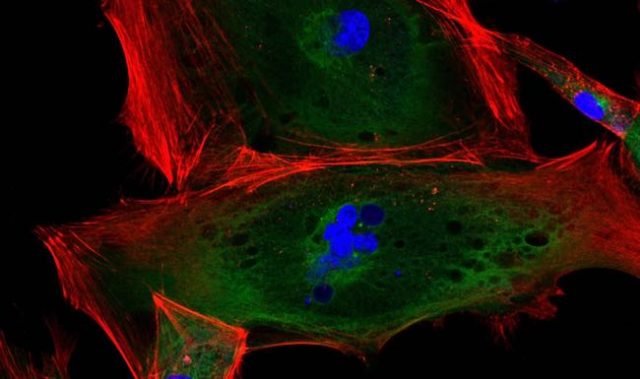
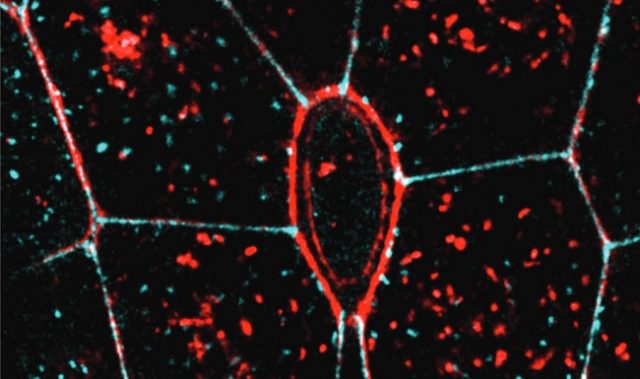
AsianScientist (Apr. 7, 2015) – The inherent ‘handedness’ of molecular structures directs the behavior of individual cells and confers them the ability to sense the difference between left and right, according to a study published in Nature Cell Biology.
Our bodies are made up of hundreds of different types of cells, each of which performs a unique and highly specialized task. Traditionally, the ability of cells to specialize in a given function was attributed to its genetic code. However, it is becoming increasingly clear that cells do not simply live by a set of inherited or pre-determined instructions. Instead, ‘cellular decisions’ are made dynamically, much like humans make decisions based on the information provided to us by our senses.
Scientists have long been intrigued about whether cytoskeleton dynamics can direct the behavior of different cell types. To investigate this possibility, MBI researchers Professor Alexander Bershadsky and Dr. Tee Yee Han, in collaboration with researchers from the US and Israel, observed the cytoskeleton in cells that were confined to a small circular area, using a technique known as micro-patterning. This prevented the cells from changing shape and thus provided the researchers an unhindered view of cytoskeleton dynamics.
What was detected came as a surprise to the researchers. A pronounced left-right asymmetry was observed during cytoskeletal organisation. This asymmetry, which appeared as a whirlpool, with filaments moving anticlockwise inside the cell, was found to originate from the inherent twist that is present in individual actin filaments. This helical twist occurs naturally as individual actin proteins join together to form the long actin cables that make up overall structure.
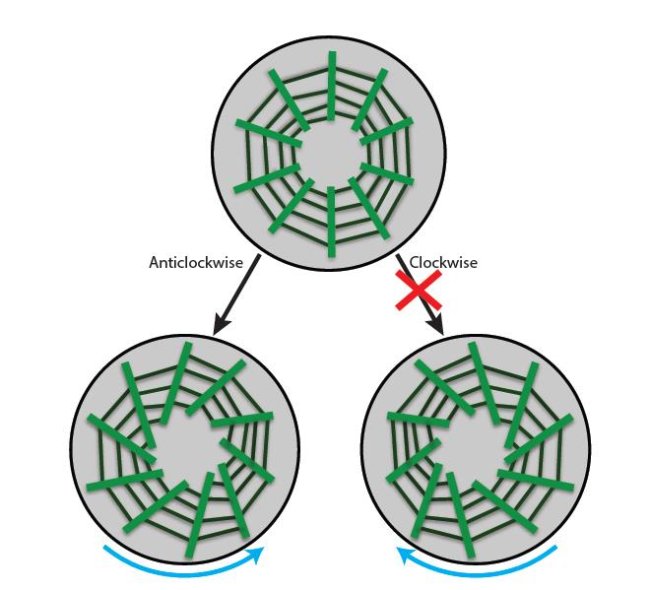
This seemingly simple property has profound consequences as it suggests that the asymmetry of a single protein is translated to the asymmetric behavior of a whole cell. This is akin to the twist of a screw or bolt directing the function or behavior of the machine in which it is placed.
The ability of cells to distinguish between left and right is a phenomenon that continues to fascinate scientists. It is clear from this study that the asymmetry inherent in molecular structures can define the behavior of whole cells, and this provides new insight into the ability of cells to ‘make decisions’ based on the mechanical properties of its environment.
However, these findings also raise questions as to whether the same phenomenon can influence the formation and function of our organs, or even affect organism behavior. Indeed, relatively simple biological systems, such as cells grown on defined patterns, display a pronounced asymmetry in their movement. At the other extreme, brain function and human cognition are dependent on the asymmetric behavior of nerve cells. The possibility that the inherent asymmetry of molecular structures can define cell, tissue or even organism behavior will undoubtedly drive further studies for years to come.
The article can be found at: Tee et al. (2015) Cellular Chirality Arising From The Self-organization Of The Actin Cytoskeleton.
———
Source: Mechanobiology Institute Singapore.
Disclaimer: This article does not necessarily reflect the views of AsianScientist or its staff.