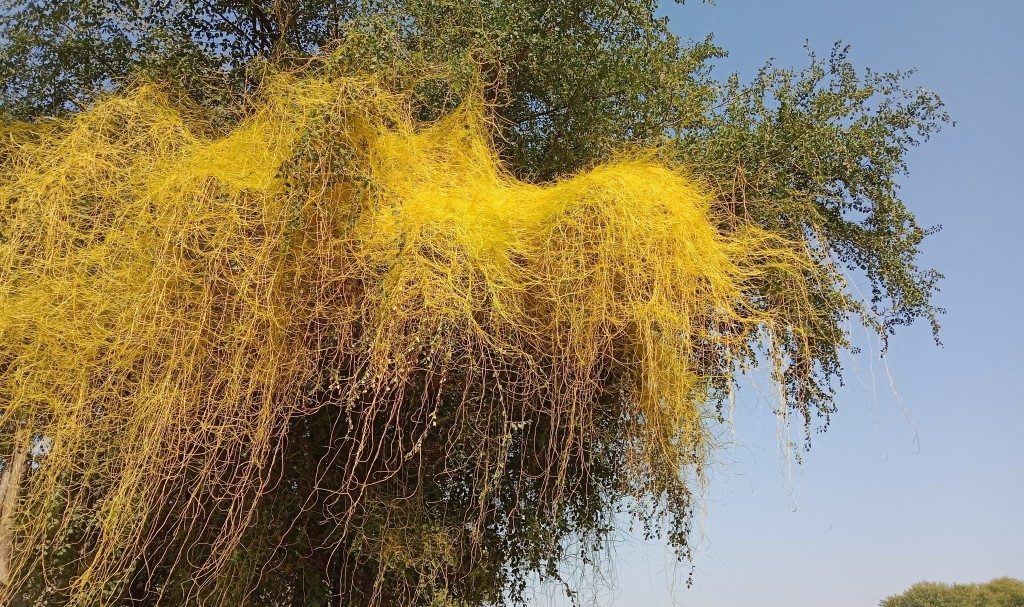
AsianScientist (Sept. 20, 2026) – Dodders (Cuscuta species) are parasitic vines that look like a bright pile of yarn, entwining their hosts and stealing their nutrients. They do so by plunging straw-like structures called haustoria into other plants, allowing materials to move between them. Scientists have now discovered that dodders do more than siphon away sustenance. They can also take genes.
Lacking chlorophyll, dodders cannot photosynthesise well, but they can still produce a surprisingly diverse range of specialised chemicals. One of them is sesamin, a lignan compound with antioxidant properties.
Best known from sesame (Sesamum indicum) and its relatives, sesamin production in a distantly related species such as Cuscuta tipped off scientists about potentially “stolen” genes through horizontal gene transfer (HGT). Rather than inheriting a gene from a parent, HGT allows genetic material to move between unrelated organisms.
In a new study published in Plant Physiology, a team led by researchers from the Graduate School of Agriculture at Osaka Metropolitan University in Japan showed that dodders not only borrowed a gene for making sesamin from a host plant in the distant past, but also remodelled it over millions of years while integrating it to its metabolic repertoire.
In sesame, production of sesamin depends on an enzyme called piperitol or sesamin synthase (PSS), which is encoded by the SiCYP81Q1 gene. The team identified closely related CYP81Q genes across multiple Cuscuta species, and all of them encoded functional PSS enzymes capable of making sesamin.
Phylogenetic analyses revealed that CYP81Q was likely horizontally transferred from another flowering plant in the order Lamiales—a group that includes sesame—to an ancestral dodder between 50 and 32 million years ago.
To explore how this HGT may have occurred, the researchers found that the dodders, C. campestris can parasitise S. indicum, and that this interaction increased the expression of SiCYP81Q1 in sesame. An incompletely processed form of SiCYP81Q1 RNA was also detected in the dodder stem, suggesting that host RNA may have crossed into the parasite and contributed to the gene transfer.
Importantly, comparative genomic analyses showed that this transferred gene underwent extensive structural changes over evolutionary time. It gradually accumulated introns—additional sections of DNA that are removed from the gene’s RNA before it is used to instruct protein production. Many of these introns contained mobile pieces of DNA called transposable elements or “jumping DNA”, which may have allowed the insertion of these new sequences.
Despite these alterations, the intron-rich Cuscuta CYP81Q preserved its function and was stably maintained in dodder genomes as the plants diversified.
Taken together, the findings suggest that acquiring a gene may be only the beginning of HGT. Once a useful gene enters a new genome, it can be reshaped over millions of years as it settles into a new organism.
The study therefore shows an underappreciated way in which parasitic plants expand their metabolic capabilities by acquiring and remodelling genes from their hosts, turning them into a lasting part of their biology.
—
Source: Osaka Metropolitan University ; Image: AlyarMSD/shutterstock
This article can be found at Transposon-colonized intron gain follows parasitism-mediated horizontal transfer of a cytochrome P450 gene.
Disclaimer: This article does not necessarily reflect the views of AsianScientist or its staff.