AsianScientist (Apr. 23, 2026)–A flower’s colour is often its loudest advertisement. In the fierce competition for attention, brighter and more distinctive blooms are expected to draw the most visitors, while less conspicuous ones fall behind. But if vivid colours win the race for bees, how do the less showy flowers still manage to attract them?
The answer may have less to do with how flowers look and more to do with who is already visiting them. For pollinators navigating landscapes where familiar resources dry up and every exploratiory flight carries a risk of wasted effort, the sight of other bees already feeding can be just as influential as colour.
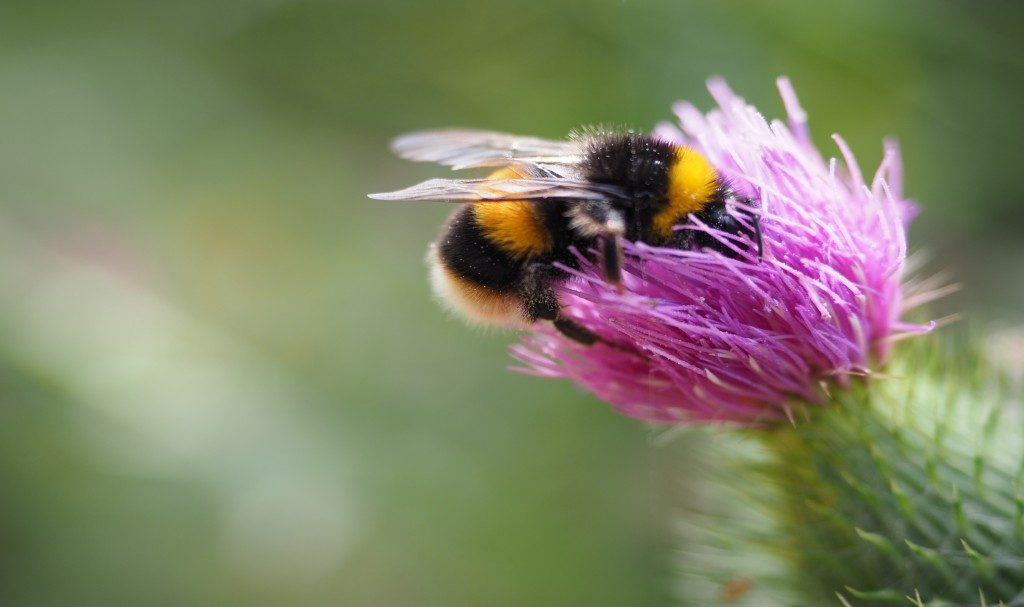
In a study published in Functional Ecology, a team from the University of Tsukuba, Kyoto University and the National Agriculture and Food Research Organisation in Japan found that bumblebees given a choice between flower patches could override or even cancel out their innate colour preferences when they spotted other bees already foraging nearby.
The researchers set up a large outdoor flight arena spanning 20 to 30 meters, roughly the scale at which bumblebees naturally switch between flower species in the wild. They then trained 62 worker bees from Bombus ignitus colonies to forage on white artificial flowers. Once the nectar reward declined, the bees were nudged to find a new target among two newly introduced patches of different colours – purple versus yellow, and orange versus blue.
To simulate early visitors, five dead bees were mounted on the less preferred flower patch. Three were wired directly onto flower petals, and two were suspended just above the patch, creating the impression of a small group of foragers actively working the flowers.
When no early arrivals were present, the bumblebees behaved as expected, favouring purple over yellow and orange over blue in roughly 90% of their foraging trips. This baseline confirmed that, on their own, bees have strong visual biases.
But when dead bees were placed on less attractive patches, that preference no longer held. Bees began approaching the occupied patches more frequently and became far more willing to commit once they got close.
Landing probability on non-preferred flowers jumped from below 10% to between 60 and 80% when early arrivals were present. As more landings produced more rewarding experiences, and through reinforcement, the bees gradually shifted to the occupied patches. The two competing signals, innate colour preference and the presence of other foragers, effectively cancelled each other out.
“These findings suggest the possibility that the use of social information among pollinators can shape plants’ interspecific competition for pollinators in nature,” says corresponding author Lina G. Kawaguchi. “I believe this has important implications for future research on plant-pollinator interactions.”
In ecosystems where numerous species bloom simultaneously, this mechanism may help ensure that even modest-looking plants get their chance to reproduce, rather than being overshadowed by more vivid species from monopolising all pollinators.
The findings also suggest that being an early bloomer could offer a crucial advantage: by securing pollinators first, a less attractive flower may trigger a snowball effect, where one visitor draws others through social information.
In nature, getting a head start can be just as effective as being the most beautiful.
—
Source: Kyoto University; Image: wirestock/Freepik
This article can be found at: Bandwagon effects in a floral market: Early pollinator acquisition offsets colour disadvantages in less attractive flowers
Disclaimer: This article does not necessarily reflect the views of AsianScientist or its staff.