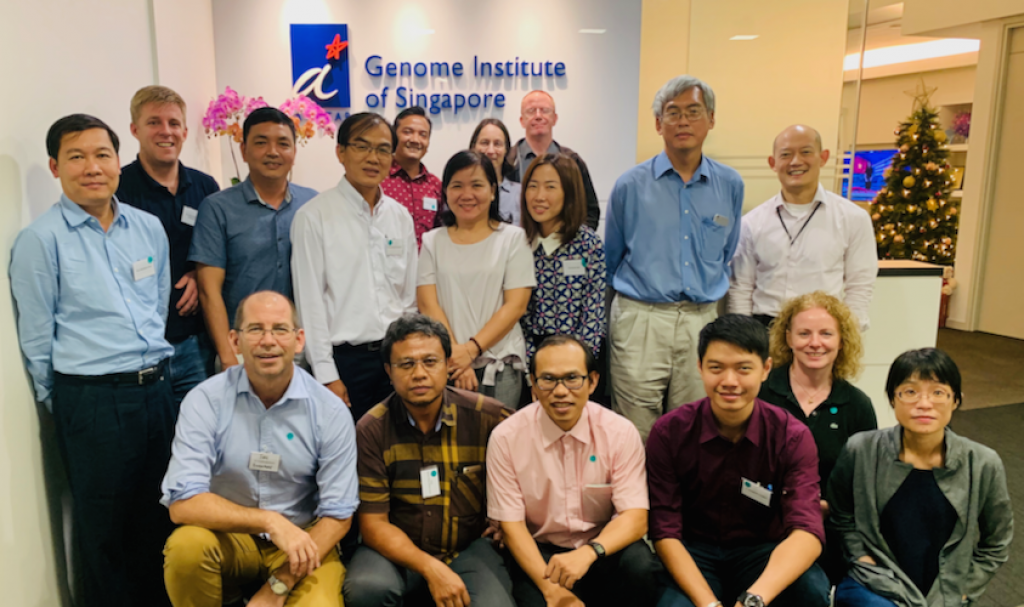
A regional response for a regionally-specific disease
While organized by scientists, the regional perspective had the additional benefit of highlighting political and development issues. The countries in Southeast Asia are organized into the ASEAN group of nations for economic, social, cultural, technical, scientific and administrative cooperation. ASEAN has long been concerned with food security and food safety: the ASEAN Food Safety Network was established in 2003, and more recently, in 2016, the ASEAN Food Safety Regulatory Framework (AFSRF) and the ASEAN Risk Assessment Centre (ARAC) for food safety were launched.
Food safety infrastructure in ASEAN countries has followed models from US and EU frameworks. In particular, known foodborne infectious agents, such as Listeria or Salmonella, have long been known outside of SEA, meaning that risk assessments, testing technology, safety regulations and mitigation actions were already established. Foodborne GBS is a regional disease, concentrated essentially exclusively in SEA, and no such safety and regulatory knowledge base exists.
One outstanding opportunity for the AFSRF and ARAC would be to tackle this first regionally-specific foodborne disease, building the regulatory and management framework and infrastructure to pre-empt any further spread of this disease both inside and outside the region. Singapore in particular is well-positioned to lead such an effort, with its upcoming integration of all food safety matters into the Singapore Food Agency and its experience in detection technology for ST283.
Lessons for infectious disease management
The 2015 GBS outbreak in Singapore was an anomaly at the time. Never before had foodborne GBS disease been described. Several years later, we now understand that foodborne GBS has been present but undetected in Singapore, and possibly all SEA, for over 20 years.
Now that we have knowledge of foodborne GBS, the connection with seafood consumption pulls on multiple threads including economics, politics, international development, and public health. The recent official ASEAN activities in food security and safety are timely and should facilitate management of these regionally specific diseases, arising from the complex interactions between unique economic systems, unique food production practices, unique food culture, or unique infectious agents. These could serve as a larger model to help inform management of other regional or tropical diseases, including those that may not be related to food, such as dengue or Zika.
Overall, the SEA-BeaST networking event was a strong beginning to assess the GBS infection risk in SEA that could support a larger and parallel ASEAN effort to ensure the safety, and widespread enjoyment, of the rich cultural food heritage found in Southeast Asia.
The SEA-BeaSt Consortium consists of public health and aquaculture representatives from Cambodia (Monidarin Chou, Daream Sok), Laos PDR (Manophab Luongray, Bounsong Vongvichith), Malaysia (Mohammad Noor Amal Bin Azmai, Mohd Nasir Mohd Desa, Syafinaz Amin Nordin), Singapore (Swaine L Chen, Timothy Barkham), Thailand (Wanna Sirimanapong, John MacArthur), Vietnam (Rogier van Doorn, Nguyen Ngoc Phuoc) and the UK (Margaret Crumlish, William Leschen, Julien Reboud, Ruth Zadoks). Additional attendees to the SEA-Beast network event included David Dance (Laos), Man Ling Chau (NEA/EHI, Singapore), Donald Jiang (AVA, Singapore), Koh Tse Hsien (Singapore), Jorgen Schlundt (Singapore), Masami Takeuchi (FAO, UN) Tran Thi Tuyet Hoa (Vietnam), Nguyen Duc Hoang (Vietnam) and Jerome Delamare-Deboutville (WorldFish). SEA-BeaSt is funded by the Scottish Funding Council through the Global Challenges Research Fund (GCRF).
———
Copyright: Asian Scientist Magazine; Photo: Mohammad Noor Amal Azmai/Universiti Putra Malaysia.
Disclaimer: This article does not necessarily reflect the views of AsianScientist or its staff.