AsianScientist (Jul. 31, 2018) – Fulfilment and a sense of accomplishment are what most people look for in their professional pursuits. For some, being a doctor checks those boxes—after all, curing disease and touching lives is a noble calling. But do aspiring doctors really know what that calling entails, and are they aware of the full range of possibilities in the field of medicine?
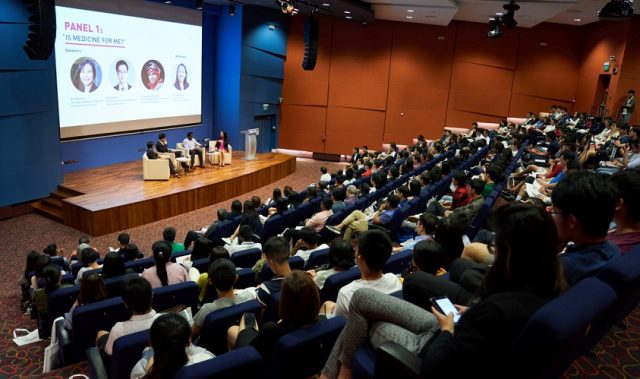
Helping to clarify these questions were seven eminent doctors at Wildtype Media Group’s So You Want To Be A Doctor? seminar, held on July 21, 2018 at the Shaw Foundation Alumni House of the National University of Singapore (NUS).
A full-house crowd of 300 students and parents gathered to get a glimpse into the medical profession through the eyes of doctors and hear about the possibilities that a medical degree unlocks for them.
If you missed the chance to attend this event, we bring you ten of the most interesting questions that were raised and answered during the seminar.
- How will the clinical landscape change in the future?
Professor Wong Tien Yin, medical director, Singapore National Eye Centre (SNEC), and vice dean, Duke-NUS Medical School, Singapore: New models of care will emerge beyond 2020, shifting from the hospital to the community, from a quality-based approach to a value-based approach. There will also be an increasing focus on preventive medicine. Moreover, with our progress in science and research, you are going to see disruptive technologies like robotics, bionics and artificial intelligence help treat patients better.
In addition, healthcare is moving from a doctor-centric approach towards inter-professional, team-based care. Nurses, pharmacists and allied health professionals are all part of the team.

Professor Wong Tien Yin sharing about the healthcare trends on the horizon. - What are some of the crucial challenges faced in healthcare today?
Wong: The first challenge is an aging population, which has led to a drop in the number of students and consequently, our manpower in healthcare.
Yet another challenge is finding solutions for long-term and intermediate long-term care—how do we manage chronic diseases such as hyperglycemia, hypertension and hypercholesterolemia?
In addition, the cost of healthcare has ballooned, quadrupling in Singapore. Add to that patients becoming more demanding, and [you get a situation where] there is a growing need for individualized solutions.
- Are there any skillsets that aspiring physicians should look to attain in today’s highly multidisciplinary and competitive setting?
Wong: We need clinician scientists, clinician innovators and clinician leaders. We need people who can teach, who innovate and bring new products into the healthcare space. We also need people who understand health informatics, specializing in data science and predictive analytics.
But that’s not all. People who can design hospital systems and those trained in social sciences are also needed. These are skills that I encourage all of you to think about— either you have them before you begin your medical career, or you will have to build them over time.
- How do physicians juggle their clinical commitments with their personal pursuits?
Dr. Kumaran Rasappan, senior orthopedic surgical resident, Tan Tock Seng Hospital, Singapore: Traditionally, you have to be good in your clinical practice before you can think of doing other things. You are primarily a clinician, and all other aspects, like clinical research or teaching, comes after your role as a clinician.
It is about balancing your time, and it can be difficult. But having an inspiring mentor that supports your aspirations can make a huge difference. Remember, certain things can only be done at a certain point in your life.

Dr. Kumaran Rasappan recounting how he took a year off to prepare for an expedition to Mount Everest. - How do I know if medicine is the right choice for me?
Assistant Professor Isaac Liu Desheng, pediatric nephrologist, National University Hospital (NUH), Singapore: Medicine can be a trying career. You will definitely need passion—if you want your life and your work to make a real difference, then I think that is the reason to choose medicine.
Wong: Passion is probably the most important thing, if you do not feel strongly about [medicine and healthcare], you will have to re-examine your decision to pursue a medical degree. You need to wake up each day and enjoy what you do. That is the kind of passion that will sustain you as a doctor.

Dr. Isaac Liu explaining how his passion led him to become the the chief doctor for the Shaw-National Kidney Foundation Children’s Kidney Center Annual Camp. - What are the advantages of having a medical degree before working in public health?
Dr. Tiah Ling, emergency medicine consultant, Changi General Hospital, Singapore: During my time in Ghana, my background in medicine helped me to understand how the local healthcare systems could be improved. Being a doctor also enhanced the conversation with local communities; it is different when you stand up there and speak as a physician. Having said that, I have seen very impressive public health administrators with non-medical backgrounds. However, that has a lot to do with your experience and familiarity in the field and work you do.

Dr. Tiah Ling describing her experiences in Afghanistan and Ghana. - How do clinician-scientists differ from physicians?
Dr. Chester Drum, assistant professor, NUS: Every doctor is a scientist. For clinician-scientists like ourselves, we accentuate the scientist aspect a little bit more than others. As a physician, the emotional connection to people brings about a unique experience unlike any other career.
However, it is not the same kind of reward as positing a scientific solution for a complex question that can change the world. The nice thing about being a clinician-researcher is that you get that emotion connection, but also the intellectual benefit of contributing knowledge to something that no one else knows.

Assistant Professor Chester Drum talking about the satisfaction he derives from making scientific discoveries. - What are the benefits of pursuing an MD/PhD for clinical research?
Dr. Swaine Chen, assistant professor, NUS: If you want to learn to do research, then learn to do research; that is what the PhD training is for. Nonetheless, a lot of clinical research is driven by the aim of improving healthcare, such as tackling diseases that we don’t understand. Without the medical training, I think that you will lose something when conducting such research.
Clinician-scientists also have it easier when running a clinical trial. To simplify, you would want to learn mathematics from mathematicians, not someone who studies Shakespeare.

Research and clinical practice complement each other, said Assistant Professor Swaine Chen. - How should I plan for a career in medicine (or any other field)?
Dr. Benjamin Seet, executive director of the biomedical research council at the Agency for Science, Technology and Research, Singapore: It is very important to know what you want to be and why you want to do it. I wrote down my plans in a diary and years later, it allowed me to reflect on my decisions and put my life in perspective. But no matter how much you plan, plans always change.
Whatever you do, enjoy it while it lasts. I did many things throughout my career, but at the end of day, I did it, enjoyed it, and when it was time to move on, I moved on.
Finally, don’t always listen to advice. I have been told three times at different stages of my life that I would be committing career suicide. If I had listened to that advice, I wouldn’t be where I am today.

Dr. Benjamin Seet giving students advice on how to plan a career. - How do you keep yourself motivated in what you do?
Liu: I think that for most of us, there were multiple times in our career where the going gets tough. Ultimately, it boils back down to passion and the reason why we do what we do. The passion that brought you into medicine in the first place will be the thing that keeps you going.
Drum: The justification that the impact of your discovery can shape the future of medicine is what really makes it exciting.
Seet: You need to know what you want. For me, there is always a pull, there is always something a little more. I always see a greener pasture, and having explored enough in one field, I would say, let’s move on to the next and see what is it like.
———Copyright: Asian Scientist Magazine; Photos: Cyril Ng/Wildtype Media Group.
Disclaimer: This article does not necessarily reflect the views of AsianScientist or its staff.