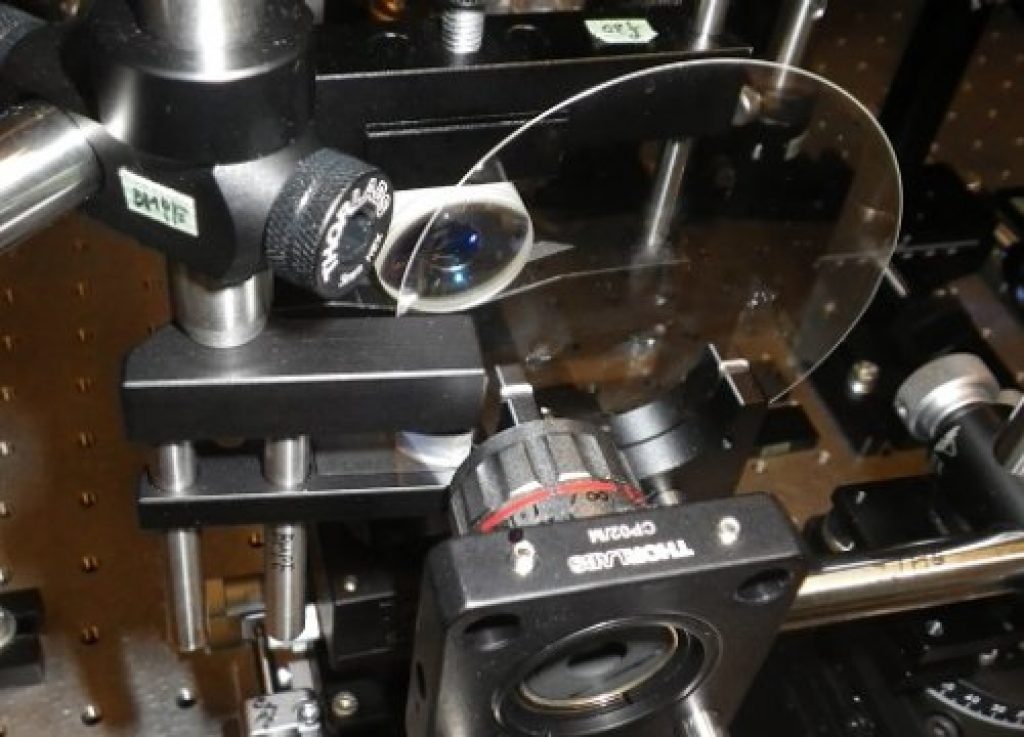
AsianScientist (Aug. 21, 2014) – Physicists at the University of Tokyo have devised a new way to film videos of processes that last only trillionths of a second, in research that was reported in Nature Photonics.
High speed video is an invaluable tool for studying processes that occur very quickly, such as chemical reactions and plasma physics. Commercially available cameras can record anywhere from millions to billions of images per second. In the scientific world, the “pump-probe method” is currently the fastest method of imaging, able to record video with an interval of just 100 femtoseconds between images—a whopping ten trillion images per second. However, the major disadvantage of pump-probe imaging is that it requires a process to be repeated many times to build up the images recorded, making it unsuitable for studying dynamic or probabilistic events.
“We wanted to study complex, non-repetitive phenomena on the micrometer scale,” explained Professor Keisuke Goda, professor of physical chemistry at the University of Tokyo, “but there was no good method for the purpose. So, we decided to develop a camera which is fast enough to capture such phenomena.”
This camera operates on a principle which the researchers have named sequentially timed all-optical mapping photography (STAMP). A laser is used to illuminate the target, much like a photographer’s flash, but the laser is processed before and after striking the target in order to separate successive frames rapidly.
First, the laser passes through a “temporal mapping device” which makes use of a slight spread in the wavelength of the laser light. Slightly longer wavelengths of light take less time to pass through the temporal mapping device, causing the laser light to be separated into successive short pulses. Each pulse hits the target at a slightly different time, creating successive individual images; then, the pulses pass through a “spatial mapping device”, which projects the different images onto different areas of an image sensor simultaneously.
“As such, STAMP is able to spatially separate successive 2D photographs in the optical domain, while satisfying the condition for image formation on the image sensor. The all-optical frame separation without any active mechanical or electronic components eliminates the speed bottleneck in conventional burst cameras, enabling multi-dimensional motion picture photography at an unprecedented frame rate of more than four trillion frames per second,” Professor Goda told Asian Scientist Magazine.
The STAMP camera holds great promise for studying fast dynamics in photochemistry, spintronics, phononics, fluidics, and plasma physics. To show STAMP’s utility, the researchers demonstrated high-speed movie shooting of the generation and propagation of a phonon—a vibrational wave in a crystalline lattice—as an example. While this phenomenon was previously difficult to observe with traditional high-speed cameras, the researchers were able to capture footage of the phonon with their new device at sufficiently high resolution and speed to observe important details.
It is anticipated that the camera will also be useful for studying other problems in science, industry and medicine, as the image-recording method behind STAMP is not limited to optical wavelengths and could in principle be extended to infrared, terahertz, X-ray and even electronic imaging.
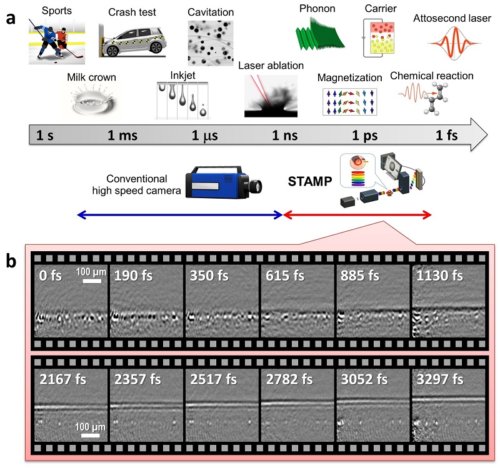
b. Observation of electronic motion and atomic lattice vibrations with STAMP. Credit: adapted from Nature Photonics 10.1038/nphoton.2014.163 ©.
The article can be found at: Nakagawa et al. (2014) Sequentially Timed All-Optical Mapping Photography (STAMP).
——
Copyright: Asian Scientist Magazine; Photo: Keisuke Goda.
Disclaimer: This article does not necessarily reflect the views of AsianScientist or its staff.