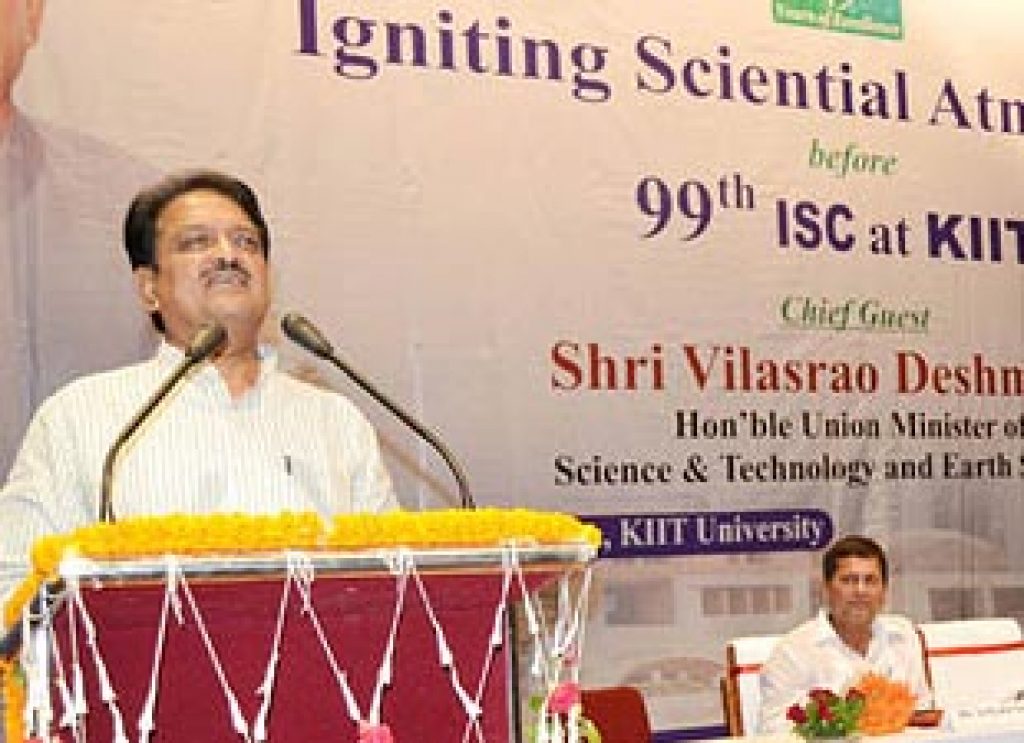
AsianScientist (Jan. 5, 2012) – At the five-day 99th Session of Indian Science Congress held at Bhubaneswar from January 3-7 this week, the Indian Minister for Science & Technology and Earth Sciences, Shri Vilasrao Deshmukh, pledged to make India a major player in science before the end of 2017.
The minister described how India had risen from a shattered economy since its independence through its investments in R&D, which led to halving of the infant mortality rate from sixty years ago and more than doubling the average life expectancy.
Shortages in food and milk supply were also addressed through the green revolution and white revolution respectively, he said.
The science minister echoed Prime Minister Manmohan Singh, who in his inauguration speech, promised that investment into R&D would be increased from the present level of less than one percent to two percent of the GDP by the end of the 12th Five Year Plan in 2017.
Deshmukh then stressed the importance a “paradigm shift in our mindsets of developing ‘policy for science’ to developing ‘science policy for people’.”
“We need big ideas in science, new methods in governance of R&D systems, right investment of resources, aspiration to emerge as world leader in science and dedication to serve the people of India through the tools of technology and affordable innovations,” he said.
The minister also highlighted the need to enhance the role of women in science through policies and programs to allow innovation leaders to emerge from among them.
Finally, he provided updates on several new programs from his Ministry, such as the “Monsoon Mission” that will soon be launched by the Ministry of Earth Sciences; an earthquake study through deep-borehole investigation in the Koyna-Warna area of Maharashtra; and a North East Center for Technology Application and Reach (NECTAR) established at Shillong by the Department of Science & Technology, among others.
——
Source: Press Information Bureau, Government of India.
Disclaimer: This article does not necessarily reflect the views of AsianScientist or its staff.