AsianScientist (Nov. 14, 2017) – A group of researchers at the University of Tokyo and their collaborators in Germany have demonstrated that a dynamic transition in health state occurs at the onset of disease. They published their findings in the Proceedings of the Royal Society B Online Edition.
The onset of disease can be perceived as the dynamic transition of the body’s internal state, and the study of such disease dynamics have been drawing attention for their potential to inform the prediction of transitions into or between disease states. However, the lack of appropriate data and corresponding analytical techniques for making such predictions has hampered the translation of these ideas into clinical applications.
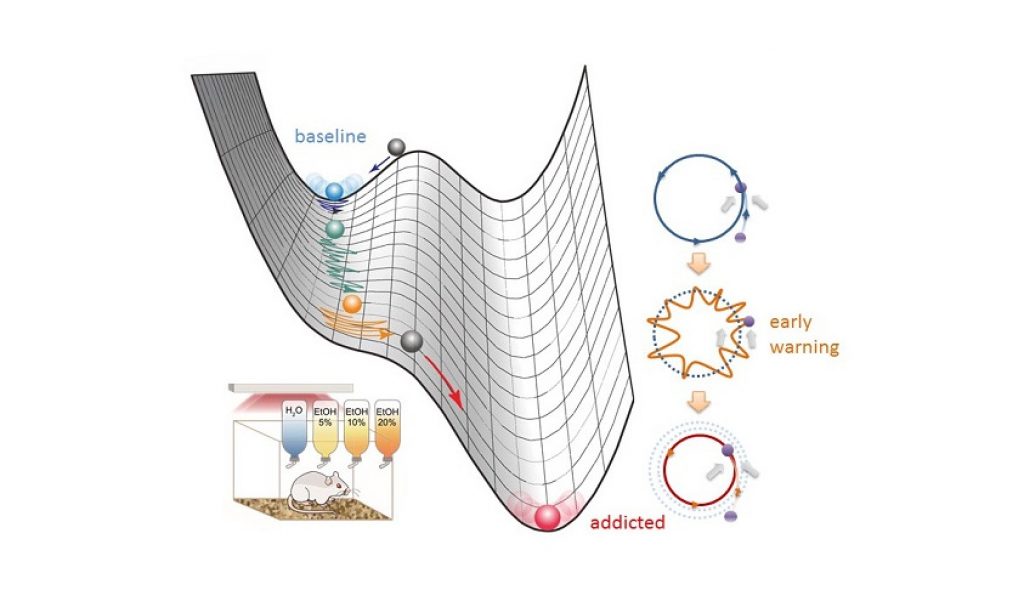
In this study, a team of researchers led by Professor Yoshiharu Yamamoto and Mr. Jerome Foo at the University of Tokyo’s Graduate School of Education used the well-established alcohol deprivation effect (ADE) model in rats to induce relapse-like excessive drinking, as an example of disease onset. This involved allowing rats to consume alcohol freely for an initial period, followed by deprivation and subsequent reintroduction of the substance.
Over a period of 14 weeks (8 baseline, 2 deprivation, 4 reintroduction), the researchers acquired continuous and high-resolution intensive longitudinal data of drinking behavior and locomotor activity. They also analyzed the data using a multiscale computational approach.
They found that transitions into addictive drinking behavior were preceded by predictive ‘early warning signals,’ such as unstable drinking patterns and instability in locomotor circadian rhythms, where the 24-hour cycle is fragmented into what is known as low-frequency ultradian rhythms of a few to several-hour diurnal cycles. Such abnormalities were detected as early as during the week of the deprivation period.
The current findings are particularly relevant today, in which rapid developments in wearable and mobile biomedical sensing technology allow us to gather massive amounts of such biomedical intensive longitudinal data.
The analytical framework developed in the present study has the potential of contributing to our understanding of disease onset in humans and forecasting changes into different stages of disease. Such knowledge can be directly translated to the clinical arena through the appropriate use of these technologies for disease prevention.
“We believe that our approach provides a significant step forward for biomedical and biophysical scientists who perceive disease onset as the dynamical transition of the body’s internal state,” said Yamamoto. “Rigorous treatment of intensive longitudinal data, like in our proposed framework, may illuminate future aspects of biomedicine and health care in the era of the IoT (internet of things) era.”
The article can be found at: Foo et al. (2017) Dynamical State Transitions into Addictive Behavior and Their Early-warning Signals.
———
Source: University of Tokyo.
Disclaimer: This article does not necessarily reflect the views of AsianScientist or its staff.