AsianScientist (Aug. 12, 2016) – Researchers in Japan have developed a superconducting material based on platinum, which was until recently thought to be unsuitable as a superconducting material. Their study was published in the Journal of the American Chemical Society.
When cooled below a certain temperature, superconductors conduct free-flowing electricity without it being impeded by resistance. They are used in magnetic resonance imaging machines, magnetic levitation trains and particle accelerators like the Large Hadron Collider.
Researchers are constantly on the lookout for cheaper materials that can become superconducting at temperatures that are higher than currently possible.
Led by researchers from Hokkaido University, the research team developed the material by mixing lanthanum, platinum and arsenic powders and compressing them into pellets. These were then heated to 500°C for ten hours. The resultant material was ground and re-pelletized, then heated at 1,000°C for an hour at various pressures.
The team found that the final product, LaPt5As, was non-superconducting at a pressure of five gigapascals (GPa), which is equivalent to 50,000 bars of pressure. But the same product became superconducting at 10 GPa, only to return to a non-superconductive state at 15 GPa.
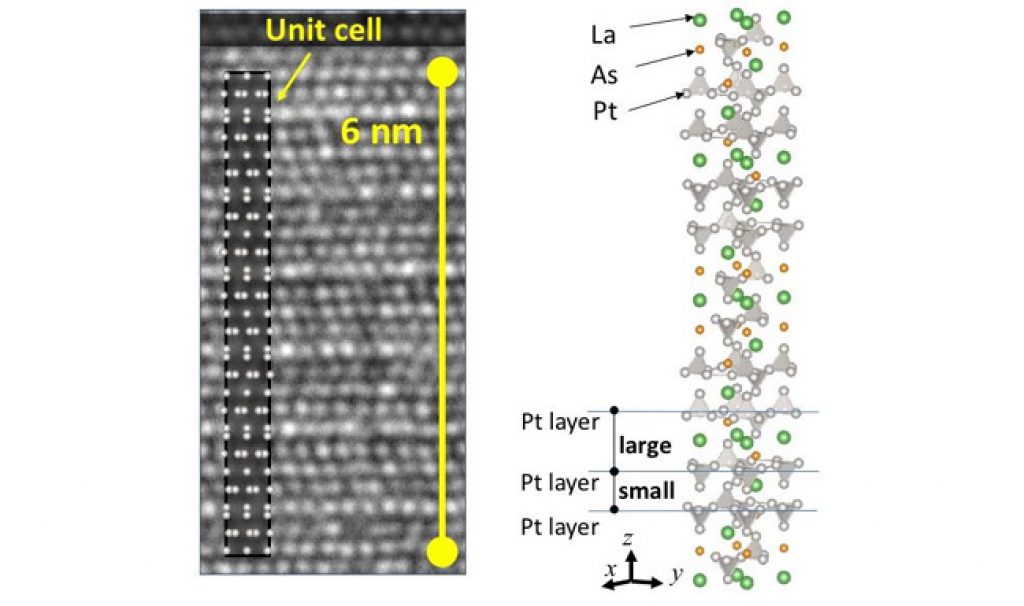
When the researchers examined the crystal structure of the superconducting LaPt5As, they found that lanthanum and arsenic atoms separated platinum layers from each other in a way which, they speculated, weakens the interaction between the platinum electrons. The weakened interactions allowed the platinum electrons to flow more freely, resulting in the superconducting property.
High-pressure synthesis of over 10 GPa is an uncommon method in the field of materials science, and this research shows that there is room for further exploration of unknown phases induced by high pressure in a variety of materials, said the researchers.
Future research that determines the detailed crystal structure of the non-superconducting phases of LaPt5As will aid in the understanding of the mechanism that causes the material to become superconducting at 10 GPa, they added.
The article can be found at: Fujioka et al. (2016) Discovery of the Pt-Based Superconductor LaPt5As.
———
Source: Hokkaido University.
Disclaimer: This article does not necessarily reflect the views of AsianScientist or its staff.