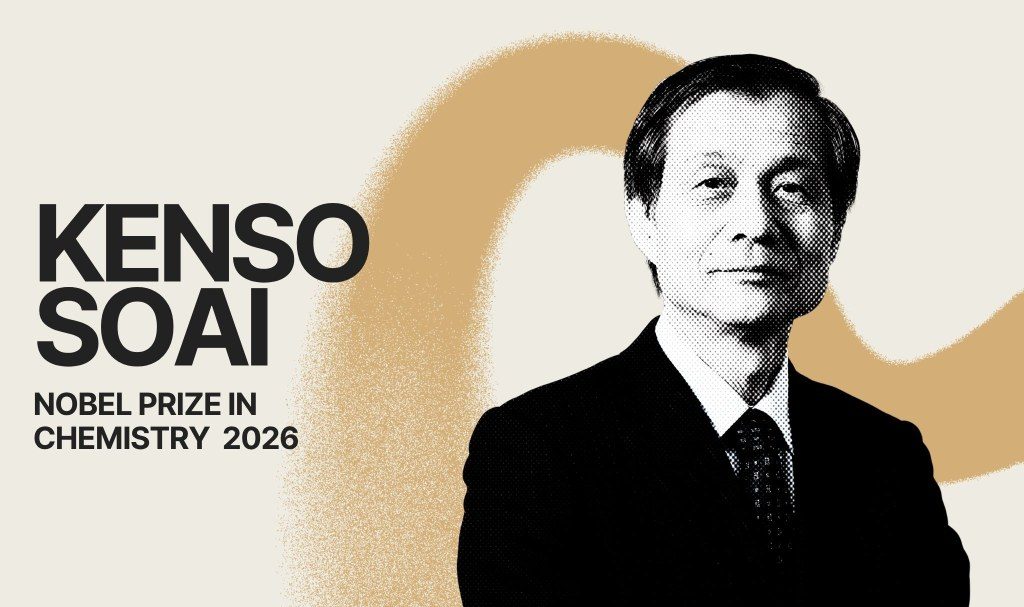
AsianScientist (Oct. 09, 2026) –Kenso Soai, Professor Emeritus, Tokyo University of Science in Japan, and Henri B. Kagan Professor Emeritus, Université Paris-Sud in France shared the 2026 Nobel Prize in Chemistry awarded by the The Royal Swedish Academy of Sciences.
The researchers won the award for solving a long standing mystery in chemistry: homochirality. Like hands, some molecules, such as amino acids exist as two mirrored variants, but only one of them is found in the proteins in your cells. The other is rarely found in nature.
“Henri Kagan and Kenso Soai have provided a solution to a chemical mystery that is over a century old: how homochirality can emerge spontaneously. The chemical reactions they have developed are spectacular,” said Heiner Linke, chair of the Nobel Committee for Chemistry.
According to the press release issued by the The Royal Swedish Academy of Sciences, Kagan took the first decisive step in 1986, when he discovered a new way of manipulating chemical reactions. This allowed him to create a greater excess of one of the mirror images than had previously been thought possible. Soai took the next step. In 1995, a key publication describes how he designed the first ever chemical reaction that had the potential to be homochiral. In 2003, he finally succeeded. He presented a reaction in which only one of the two possible mirror images was formed. No one had previously achieved this feat.
The award citation stated that their discoveries have been decisive for chemists who design reactions for the manufacture of pharmaceuticals. Many of the drug molecules occur in two variants that are each other’s non-identical mirror image: one has the therapeutic effect, while the other can cause unnecessary and sometimes harmful side effects.
Around the world, researchers are now trying to repeat Soai’s achievement, but with the aim of producing homochiral amino acids and sugars.
The non-linear effects that Kagan discovered have become an important tool for chemists when they design new reactions. The fact that a reaction is non-linear provides chemists with information about how it occurs. This information can be used to optimize the reaction, so they can obtain the purest possible enantiomers of the product. This is vital for every company that manufactures substances that are intended to interact with living beings, such as pharmaceuticals, flavors, scents and agricultural chemicals. In some cases, it is also important in the production of new materials.
———
Source: The Royal Swedish Academy of Sciences; Image: Ajun Chuah/Asian Scientist Magazine.
Disclaimer: This article does not necessarily reflect the views of AsianScientist or its staff.