AsianScientist (Apr. 29, 2026)– In the natural world, animals usually rely on their own genes to produce the traits they need to survive. These genes act like instruction manuals, telling the body how to make important molecules, including proteins that perform specific functions.
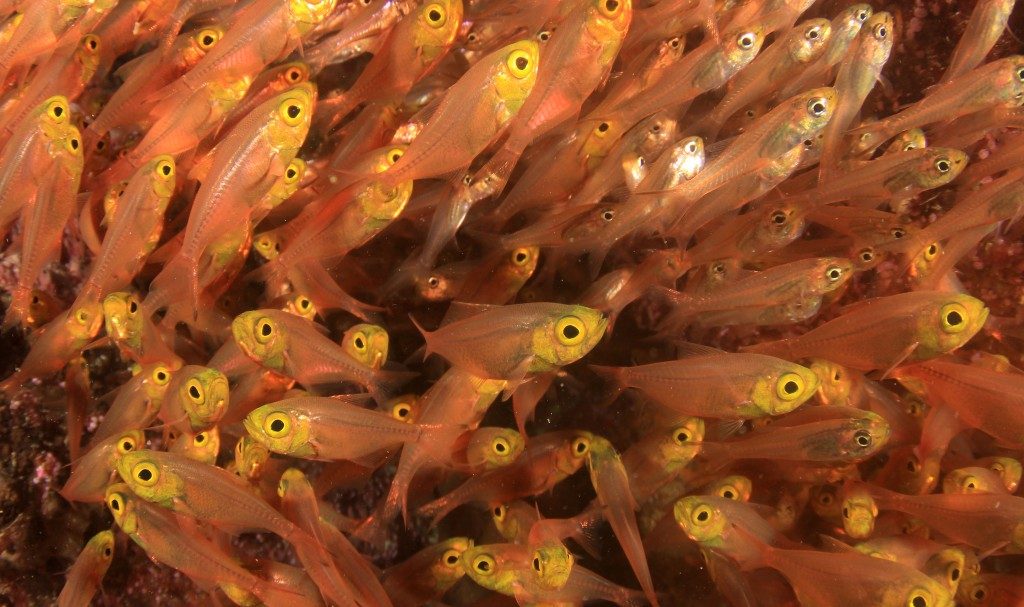
Researchers from Tohoku University in Japan have now found an exception: the golden sweeper (Parapriacanthus ransonneti), a schooling reef fish. They discovered that the fish can glow in the dark, not by making its own light-producing protein, but by “stealing” it from the creatures it eats.
The golden sweeper obtains luciferase – the protein responsible for producing light – by feeding on bioluminescent ostracods often called “sea fireflies.”
In most bioluminescent organisms, luciferase is made within their own bodies based on instructions encoded in their genes. When luciferase reacts with other molecules, it produces light, allowing these organisms to glow.
The new study, published in Scientific Reports, stated that the case of the golden sweeper is one of the clearest examples of a rare phenomenon known as kleptoproteinism. The term comes from “klepto,” meaning to steal, and refers to organisms that take proteins from other species and use them for their own benefit. It is part of a broader phenomenon called kleptobiology.
Cracking the genetic mystery
Previously, the team had discovered that this fish obtains luciferase from sea fireflies. But one big question remained: does the fish truly lack the gene needed to make luciferase, or had it somehow acquired this gene from its prey over time through a process called horizontal gene transfer?
To find the answer, researchers carried out detailed genome sequencing of the fish, by mapping out its entire genetic code to see whether the instructions for making luciferase were hidden somewhere in its DNA.
For the study, live specimens of the fish were provided by Okinawa Churaumi Aquarium, which were originally collected by local fishermen from near Okinawa Island.
For 15 months, the fish were fed only minced non-luminous fishes or mysids, and not glowing prey like certain ostracods. This was done to make sure that no glowing proteins or DNA from their usual prey contaminated the fish’s own genetic material.
“The results provide compelling and conclusive evidence that this fish does not possess the genetic blueprint for bioluminescence,” said Manabu Bessho-Uehara, Associate Professor at the Frontier Research Institute for Interdisciplinary Sciences (FRIS), Tohoku University. “Instead, it relies entirely on proteins obtained from its prey, representing a truly unique form of biological adaptation.”
These findings provide the first definitive genomic proof of kleptoproteinism.
Why this discovery matters
This discovery opens up new ways for scientists to study how proteins can be eaten, protected from being broken down during digestion, and still remain active inside the body. In most cases, proteins consumed by humans are digested and lose their function. But in the golden sweeper fish, the protein it eats stays intact and continues to work. Understanding how this happens could help researchers develop new kinds of medicines, especially protein-based drugs, that can be taken orally instead of injections.
—
Source: Tohoku University ; Image: Rich Carey_shutterstock
The study can be found at: Absence of the luciferase gene in the genome of the kleptoprotein bioluminescent fish Parapriacanthus ransonneti
Disclaimer: This article does not necessarily reflect the views of AsianScientist or its staff.