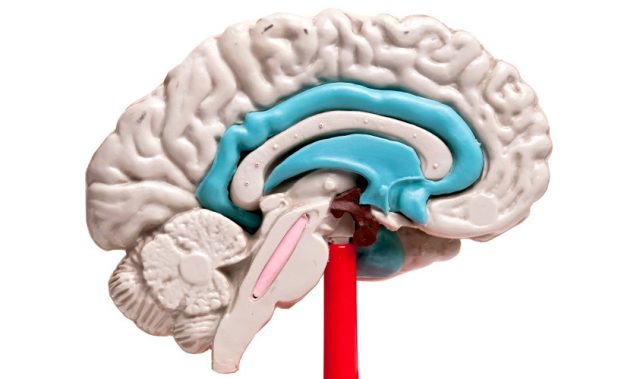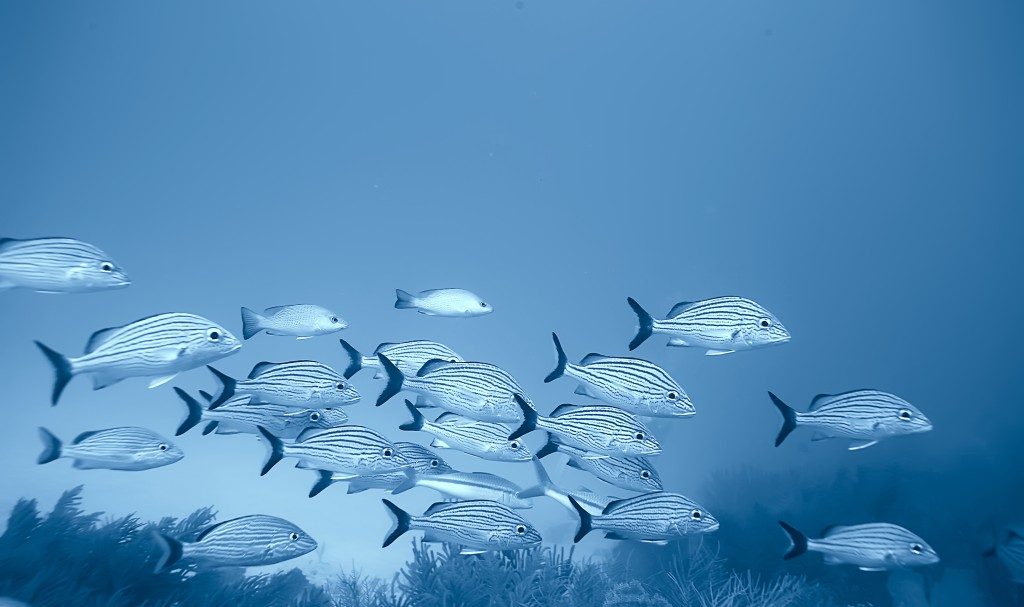
AsianScientist (Apr. 28, 2026)–Light does not reach only the eyes. In non-mammalian vertebrates such as fish, frogs, and birds, light-sensitive cells are distributed across tissues beyond the retina, including deep in the brain. One such structure is the pineal gland, a small light-sensitive organ whose cells respond directly to ambient light, and in zebrafish, it plays a role in vertical movement.
Unlike the eyes, the pineal organ does not form images. Instead, it contains specialised cells that compare different wavelengths of light, distinguishing between ultraviolet and visible light on their own. In a study published in the Proceedings of the National Academy of Sciences of the United States of America, researchers from Osaka Metropolitan University identified a neural circuit that contributes to vertical movement, influencing whether larvae swim towards the surface or the bottom in response to changes in light wavelength.
The researchers focused on parapinopsin 1 (PP1), a light-sensitive protein found in the pineal organ that can switch between two stable forms depending on the wavelength of light it absorbs. Ultraviolet light drives PP1 into an active signalling state, while visible light pushes the balance back. This allows PP1 to encode changes in wavelength rather than in brightness alone.
To trace the circuit, the research team used whole-brain calcium imaging. “The transparency of zebrafish larvae means that changes in calcium levels in nerve cells can be observed as changes in the fluorescence intensity, allowing us to measure the strength of neural activity,” said Professor Mitsumasa Koyanagi, senior author of the study.
A key challenge was isolating pineal signals from retinal ones in an intact, light-sensitive animal. The team designed a light-stimulation protocol that exploited the switching properties of PP1 itself, allowing them to distinguish pineal responses from visual input arriving via the eyes. Using this approach, they traced PP1-driven colour signals from the pineal organ to a brain region called the tegmentum.
“Our study showed that the tegmentum integrates visual information from the eyes that is combined with colour information detected by the pineal organ,” said Seiji Wada, the paper’s first author. “These integrated signals then contribute to the fish’s up and down swimming behaviour.”
To confirm the tegmentum’s role, the researchers selectively ablated the relevant neurons using a targeted laser. Larvae with these neurons showed significantly reduced vertical movement in response to light changes, while those that underwent a sham procedure were unaffected, providing evidence that the pineal-to-tegmentum circuit contributes to the decision to swim up or down.
The results suggest that zebrafish compare light inputs from two separate sensory organs and translate that information into a swimming decision. Rather than relying solely on the eyes, the brain appears to weigh colour information from the pineal organ alongside visual input, with the tegmentum acting as the integration point.
The authors note that the circuit was characterised in larvae, and it remains unclear whether similar pineal-to-tegmentum pathways operate in adult zebrafish or other non-mammalian vertebrates. If they do, the study suggests that what appears to be a simple swim up or down may be guided by a more complex comparison of light signals than previously thought.
“These findings shed light on how animals process visual information, advance the analysis of neural circuits using light, and expand research into behavioural control,” said Professor Akihisa Terakita, corresponding author of the study. “In the future, these findings may contribute to applications in neuroscience and biomedicine, such as the identification of neural circuits using PP1-based optogenetics.”
—
Source: Osaka Metropolitan University; Image: kichigin/Freepik
This article can be found at: Neural circuits for decision-making based on pineal photoreception in zebrafish
Disclaimer: This article does not necessarily reflect the views of AsianScientist or its staff.