For those who can’t decide whether to install a wall or a window
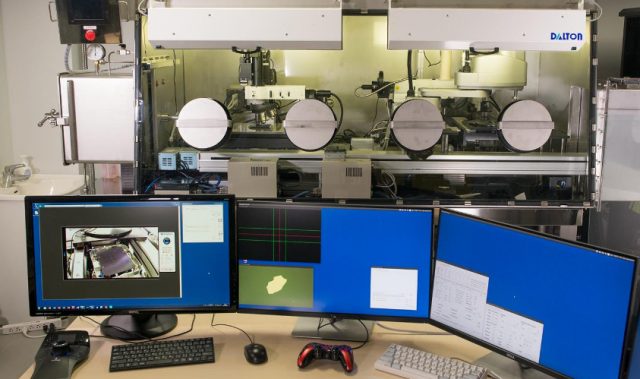
With Squama, architectural spaces can be designed with dynamically changing transparency, allowing for openness or privacy when needed.
How it works: Squama is a programmable physical window or wall whose visibility can be controlled via elemental small square modules. Shadows can also be programmed to create a more comfortable space without completely obscuring the view of the outside.
“This is an example of a programmable physical architecture where architectural elements and facades can be dynamically changed and reprogrammed according to people’s needs,” the researchers said.

When you just need a quick pick-me-up
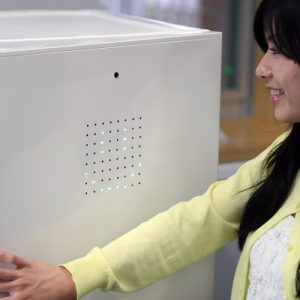
People who live alone may not have the opportunity to smile at someone every day. Happiness Counter is a digital appliance that encourages the act of smiling in our daily lives.
How it works: Happiness Counter combines visual smile face recognition, user feedback and network communication, allowing it to detect when a user smiles at it.
“According to psychological studies, the act of smiling positively affects our mental status—we become happier when we laugh,” the researchers said.
When you want to play the piano like Mozart or Beethoven
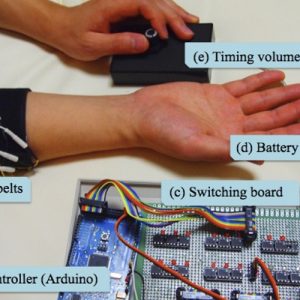
PossessedHand is a device that can be used to control human hands using electrical stimuli.
How it works: A forearm belt controls the user’s hand via electrical stimulation to the muscles around the user’s forearm. The device is portable and suitable for daily use.
“Our experiments confirmed that PossessedHand can be used to control the motion of 16 joints in the hand,” Rekimoto’s lab reported. “Navigation systems, feedback systems for recognizing virtual objects and assistant systems to play musical instruments such as the piano and the koto are some of the possible applications of such technology.”
If all you’ve wanted was to be a cat
Cat@Log is a device wearable by pets to enhance interactions between humans and their furry friends. The gadget can detect activities carried out by a cat and transmit information in real-time via a Bluetooth module.
How it works: The device consists of various sensing units such as a camera, a GPS, an accelerometer and a Bluetooth module. Various recognition algorithms, including cat face detection and activity classification, are integrated into the device. Information is then automatically sent to social media platforms such as Twitter.
“When we determined the design of Cat@Log, we considered parameters such as the device’s properties and method of attachment, so that the device can be attached to a pet without causing discomfort,” the researchers noted.
———
Source: Rekimoto Lab.
Disclaimer: This article does not necessarily reflect the views of AsianScientist or its staff.