AsianScientist (Feb. 22, 2018) – A research group in Japan has directly observed the mechanism by which the Northern lights form. They published their findings in Nature.
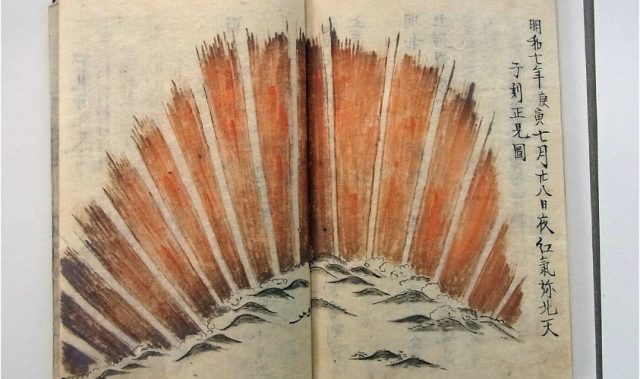
The Northern Lights are a visual spectacle—green, red and purple waltz across the night sky, blending into one another for a fantastic show widely considered one of the great wonders of the world. Among a variety of auroras, pulsating auroral patches appearing at dawn are common, but the physical mechanisms driving this auroral pulsation had so far not been verified through observation.
In this study, a team of scientists led by Associate Professor Satoshi Kasahara at the University of Tokyo in Japan has used a satellite with advanced measuring tools to identify the mechanism by which these auroras form.
“Auroral substorms are caused by global reconfiguration in the magnetosphere, which releases stored solar wind energy,” said Kasahara. “They are characterized by auroral brightening from dusk to midnight, followed by violent motions of distinct auroral arcs that eventually break up, emerging as diffuse, pulsating auroral patches at dawn.”
The global reconfiguration in the magnetosphere often causes a specific type of plasma wave, called chorus waves, to rain electrons into the upper atmosphere. A colorful light is given off as the electrons fall. However, scientists have questioned if the chorus waves were powerful enough to excite electrons to the extent of creating auroras.
“For the first time, we directly observed scattering of electrons by chorus waves generating particle precipitation into the Earth’s atmosphere,” said Kasahara. “The precipitating electron flux was sufficiently intense to generate pulsating auroras.”
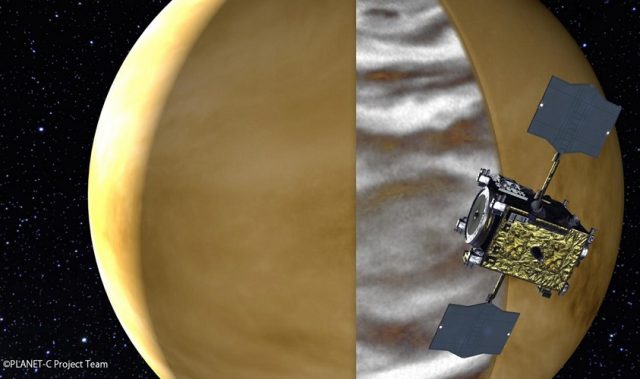
Previously, scientists could not see this direct evidence of electron scattering because typical electron sensors cannot distinguish the precipitating electrons from others. Kasahara and his team designed a specialized electron sensor that observed the precise interactions of auroral electrons driven by chorus waves. The sensor was aboard the Exploration of energization and Radiation in Geospace (ERG) satellite, also known as the Arase spacecraft, launched by the Japan Aerospace Exploration Agency.
“By analyzing data collected by the ERG spacecraft more comprehensively, we will reveal the variability and further details of plasma physics and resulting atmospheric phenomena, such as auroras,” Kasahara explained.
The article can be found at: Kasahara et al. (2018) Pulsating Aurora From Electron Scattering by Chorus Waves.
———
Source: University of Tokyo; Photo: ISAS/JAXA.
Disclaimer: This article does not necessarily reflect the views of AsianScientist or its staff.