AsianScientist (Oct. 10, 2017) – Scientists in Japan have estimated the strength of a magnetic storm that caused a red aurora to appear over Kyoto in 1770 by examining historical records of amateur astronomers. They report their findings in the journal Space Weather.
Auroras are lightshows that typically occur at high latitudes such as the Arctic and Antarctic; however, they expand towards the equator under severe magnetic storms. Past observations of such unusual auroras can therefore allow us to determine the frequency and severity of magnetic storms. Fortunately, historical documents are becoming much more accessible for research as newly discovered records surface from private collections across the world.
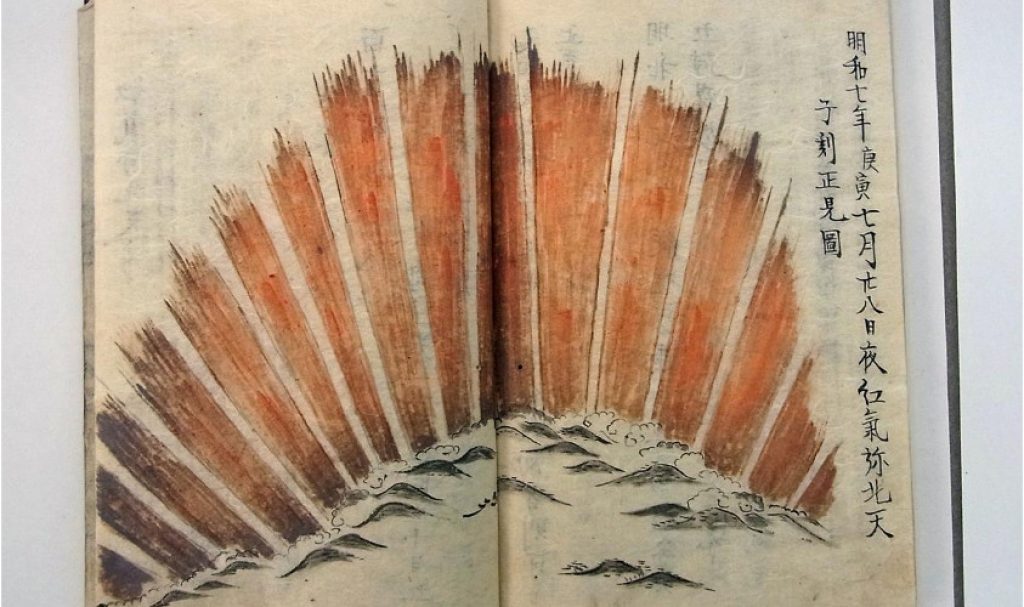
In this study, researchers centered at Tokyo’s National Institute of Japanese Literature (NIJL) and National Institute for Polar Research (NIPR) examined a detailed painting from a Japanese manuscript Seikai, translated as ‘understanding comets,’ with associated commentary that describes a red aurora occurring over Kyoto on 17 September 1770. The researchers also investigated detailed descriptions of the event from a newly discovered diary of the Higashi-Hakura family of Kyoto.
“The enthusiasm and dedication of amateur astronomers in the past provides us an exciting opportunity,” said Associate Professor Kiyomi Iwahashi of NIJL. “The diary was written by a kokugakusha [scholar of ancient Japanese culture], and provides a sophisticated description of the red aurora, including a description of the position of the aurora relative to the Milky Way.”
Using astrometric calculations of the elevations of the Milky Way as it would have been viewed from Kyoto on 17 September 1770, the researchers were able to calculate the geometry of the red aurora and check the results against the details from the Seikai painting and the diary. The accuracy of the description of the aurora in the historical documents allowed the researchers to estimate the strength of the magnetic storm that caused the September 1770 aurora.
“The magnetic storm on 17 September 1770 was comparable with or slightly larger than the September 1859 magnetic storm that occurred under the influence of the Carrington solar flare. The 1859 storm was the largest magnetic storm on record, in which technological effects were widely observed,” said Associate Professor Ryuho Kataoka of NIPR. “It was lucky for us that the 1770 storm predated our reliance on electricity.”
The researchers also used this information to estimate the frequency of such intense magnetic storms and make projections about when the next storm might arrive.
“We are currently within a period of decreasing solar activity, which may spell the end for severe magnetic storms in the near future,” said Kataoka “However, we actually witnessed an extremely fast coronal mass ejection on 10 September 2017, which might be powerful enough to cause extreme storms. Fortunately, it just missed the Earth.”
Regardless of the specific likelihood of another perfect magnetic storm, interdisciplinary historical and scientific collaborations are invaluable in providing important physical details that could help us to understand the greatest magnetic storms in history. The more information that can be gathered about these historical storms, the greater the opportunity to mitigate disruption of power grids in a future event.
The article can be found at: Kataoka & Iwahashi (2017) Inclined Zenith Aurora over Kyoto on 17 September 1770: Graphical Evidence of Extreme Magnetic Storm.
———
Source: Research Organization of Information and Systems; Photo: Matsusaka City, Mie Prefecture.
Disclaimer: This article does not necessarily reflect the views of AsianScientist or its staff.