AsianScientist (Aug. 31, 2017) – Lessons can come in many forms. Through textbooks and lectures, conversations at conferences, seeking wisdom from the more experienced, and—though this is sometimes the hardest—by simply living through life and learning from it.
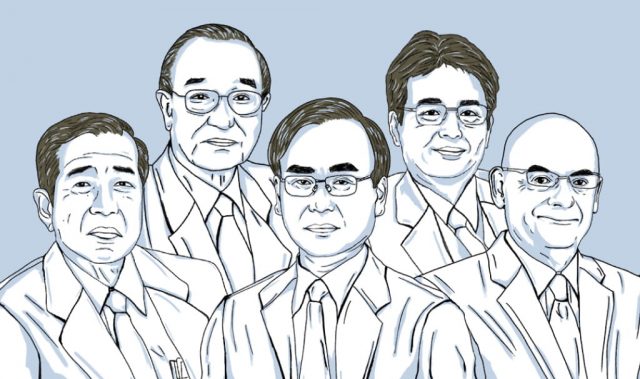
Last month, I spoke to three eminent scientists who all have been there and done that. I posed questions such as ‘What would you have done differently back then?’ and ‘If you could go back in time, what would you tell your younger self?’ There was a lot of fond reminiscing and reflection as they each recalled the seldom-straight paths that led them to where they are today.
Here are the top tips they had to offer about life on the bench and beyond:
- Looks can be deceiving
- Talk, talk, talk
- Ignore the naysayers
- Stop and breathe
- Consider the crooked line
At some stage, all aspiring scientists find themselves at a crossroads. Do I do a PhD? What should I specialize in? Which lab should I choose?
These are all big questions that can’t be answered in the course of a single day. To arrive at a good answer, one that balances aspiration with reality, takes time and due research. Barry Halliwell, an internationally-renowned biochemist who chairs the Agency for Science, Technology and Research’s (A*STAR) Biomedical Research Council, has these words of wisdom to share: don’t go for looks because they can deceive.
Big shot PIs at well-known institutions may seem sexy, but at the end of the day, it’s about who can give you the best experience for your time there, Halliwell tells me. “An up and coming lab may actually be better than a lab that’s well-established but one where you almost never get to see the PI.”
Flashes of inspiration come when you least expect it. So many people get stuck in their own little bubble, Halliwell says, not seeing what’s going on in the bigger world around them. But when you speak to different people, when you attend as many seminar series as you can, “you’ll be surprised how a new idea suddenly pops into your head.”
Halliwell, who wrote the textbook Free Radicals in Biology and Medicine that many biochemical students are familiar with, recalls his PhD days at Oxford University.
“My head of department made us attend tea three times a week at 4pm, which I thought was a waste of time because I had to plan all my experiments around that. But I found that when I had to sit next to somebody and got to talk to them, I actually got a few useful tips!”
Youthfulness can be a both a blessing and a curse. Applied physicist and mathematician John Gustafson was 25 when he came up with an idea, called Gustafson’s law in his honor, that would revolutionize the world of high-performance computing. But he tells me he had to face many detractors along the way.
“Older learned people may tell you something cannot be done, but don’t be disheartened by the ‘prevailing wisdom,’” says Gustafson, currently a visiting professor at A*STAR and the National University of Singapore. “They’re probably wrong.”
Your age doesn’t have to be a barrier, he says. Steve Jobs, Bill Gates and Mark Zuckerberg were making headlines by the time they were 25.
“As a 25-year-old, you are actually better at trying new approaches than just about any other age,” says Gustafson. “Because you have enough education to know the problems we face, but not so much experience that you are discouraged by knowing why trying to solve them will probably fail.”
We all have memories of caffeine-fueled days that blur from one to the next. Sometimes long nights in the lab and weekends at the bench are inevitable, but getting enough downtime is important too.
“A lot of people are so busy sawing, they don’t stop to sharpen the saw,” Halliwell tells me.
He shares that while it’s important to work hard, it’s equally crucial—perhaps even more so—to work smart. Halliwell recalls interviewing a potential student for a position in his lab, who had one bad reference from a supervisor who felt she wasn’t in the lab enough. The student happened to be an outstanding sportswoman, but had to balance her time on the bench with her training commitments.
It turns out the student had great initiative, says Halliwell.
“The protocol said to measure the kinase activity every 15 minutes. She decided to check the time course—which many people wouldn’t do—and realized it wasn’t necessary.” Impressed, he hired her.
“So many people just carry on working, but don’t stop to wonder if this is the most efficient protocol or way of doing things,” reflects Halliwell.
Many people find a career in the sciences comforting—you always know what the next rung of the ladder is: PhD, post-doc, tenure, and so on. But to others, this may be constricting, which is why many people switch tracks mid-way through.
“Sometimes the best path from A to B may not be the straight line,” says Steven Miller, the vice provost of research at Singapore Management University.
Miller studied engineering and public policy at Carnegie Mellon University, but wanted to try his hand at actually running a factory. So in 1989, 33-year-old Miller moved to the small town of Oyama, Japan for an apprenticeship with Fujitsu—uprooting his wife and 8-month-old daughter, and without knowing a single word of Japanese.
“Would I have changed anything?” he asks. “No, not a thing.”
“If you have what you think is a good idea—as outrageous as it might seem to others and as hopeless if one were to look at it ‘rationally and objectively’—if you are convinced it is a good idea and you have some ability to try it out, do it,” Miller says.
“It might fail. But you never know, it might just work. Or it might lead to different things, different to what you thought it would have been.”
This article is from a monthly column called Beyond The Bench. Click here to see the other articles in this series.
———
Copyright: Asian Scientist Magazine; Photo: Shutterstock.
Disclaimer: This article does not necessarily reflect the views of AsianScientist or its staff.