AsianScientist (Feb. 20, 2017) – By tweaking viral proteins, researchers at the Tokyo Institute of Technology have developed protein crystals that can be used to store foreign material inside cells. Their findings, published in ACS Nano, could be used for applications such as enzyme catalysis and intracellular drug delivery.
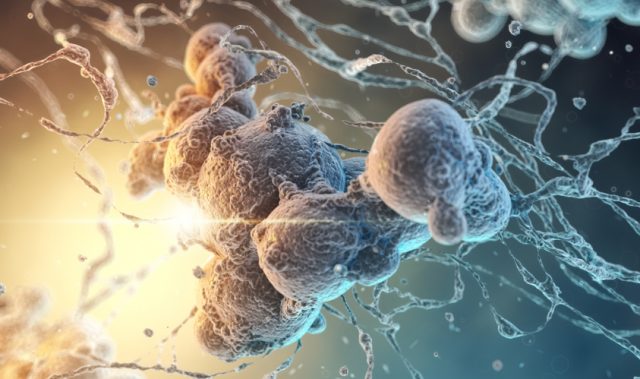
Cytoplasmic polyhedrosis viruses (cypoviruses) which infect insects are embedded in protein crystals called polyhedra which shield the virus from damage. The structure of polyhedra crystals suggests that they can serve as robust containers which can incorporate and protect foreign molecules from degradation, ensuring their functional stability.
The dense packing of polyhedrin monomers in the crystals form channels which do not allow large solutes to pass through. While this low porosity makes the polyhedra extremely stable, it also limited the researchers’ ability to incorporate foreign particles.
A team led by Assistant Professor Satoshi Abe and Professor Takafumi Ueno hypothesized that if the porous framework inside the polyhedra crystals could be extended without compromising crystal stability, the crystals could be used to accumulate and store of exogenous molecules in living cells. In particular, they tested if deleting amino acid residues at the interface of each polyhedrin trimer would increase the porosity of the resulting crystals.
To achieve this goal, they genetically engineered polyhedrin monomers, which were then expressed and self-assembled in Spodoptera frugiperda IPLB-Sf21AE, the larva of an armyworm moth, infected with baculovirus.
To analyze the tiny crystals obtained, the researchers used beamlines BL32XU and BL41XU at SPring-8, a large synchrotron radiation facility which delivers the most powerful synchrotron radiation. The high-resolution structures were rapidly analyzed with the help of an automated data collection system developed in RIKEN.
The mutant polyhedra crystals maintained the crystal lattice of the wild-type PhC but had significantly extended porosity due to the deletion of amino acid residues with the rearrangement of intra- and intermolecular hydrogen bonds. As a result, the engineered crystals could adsorb two to four times more fluorescent dye than the wild type polyhedra crystals, with up to 5,000-fold condensation of the dyes from the 10 uM solution.
As a next step, the scientists examined the performance of the mutant crystals in living insect cells. The polyhedra crystals were very stable in the intracellular environment, and, most importantly, could accumulate and retain the dyes in live cells, while the natural crystals could not.
The article can be found at: Abe et al. (2016) Crystal Engineering of Self-Assembled Porous Protein Materials in Living Cells.
———
Source: Tokyo Institute of Technology.
Disclaimer: This article does not necessarily reflect the views of AsianScientist or its staff.