Minimalist robots
The Geminoid is far from the only android in the Ishiguro imaginarium. Veering to the other extreme are robots that no one would ever mistake for humans: the child-sized Telenoid is a mere torso with a bald head and limbs that end in stumps; the Elfoid is a smaller, palm-sized version of this, meant to be used like a cellphone.
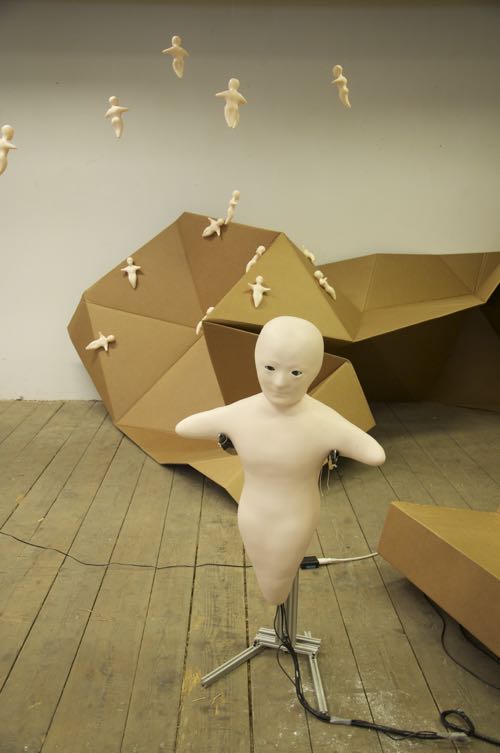
Like the Geminoid, these robots are designed to be teleoperated. A webcam and motion capture software record your voice and head and face movements, and reproduce them on the robot’s body, thus conveying your presence to the person holding it. You could, for example, hug someone via Telenoid—assuming the recipient doesn’t mind being hugged by something resembling the offspring of a crash test dummy and Casper the friendly ghost.
It’s hard to imagine this catching on as a way to communicate with your friends. In fact, faced with the robots’ jerky, doll-like movements, porcelain-white skin, and lidless, unseeing eyes, the people formerly known as your friends might even run away screaming when you call. Yet, Ishiguro said, field tests have shown that people generally react very positively to these minimalist robots.
His theory is that we recognize the two robot extremes in different ways. When interacting with human-like robots, our brains recognize them by carefully observing every aspect—face, appearance, movements and speech, for example.
“But if a robot doesn’t have any character, or if its appearance is quite different, then people can use [their] imagination to recognize it,” he explained. And, given insufficient information, the human brain tends to imagine positive qualities, he speculated.
Humanoid robots like the Geminoid are good for representing and transmitting a particular human presence—that of a famous movie star or singer, for example. But the neutral appearance of minimalist robots makes them acceptable to everybody, and allows them to be used in more general remote communication applications, Ishiguro said. He is particularly interested in using them for elderly care, where they can help stave off loneliness for older people who live alone. They can also act as educational aids, teach languages and other subjects through conversation, and guide physical exercises such as stretching.
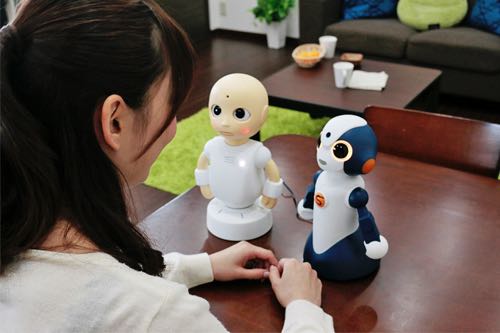
Two of the Ishiguro lab’s newest robots perhaps represent a happy medium between the Geminoid’s uncanny human likeness and the Telenoid’s tabula rasa. The CommU (short for Communication Unity) resembles a small boy with endearing, anime eyes; the Sota (Social Talker) looks like a friendly robot plucked straight out of a cartoon.
The duo, each about a foot tall, are not teleoperable and cannot understand human speech; instead, they are only capable of carrying out preprogrammed conversations with each other. But through gestures such as nodding and turning their heads and bodies to fix their gaze on each other and on the user, they are meant to give humans the sense of actually participating in a real conversation. Again, Ishiguro thinks that these robot chatterboxes can help provide the elderly with companionship and mental stimulation.
Both robots are available for purchase through robot manufacturer Vstone, with the Sota retailing for 100,000 yen (~US$883), and the CommU, which has more complex mechanics that also allow it to move its eyes, at five times as much. Nippon Telegraph and Telephone, Japan’s largest telecommunications company, hopes to begin placing Sotas in elderly care. Besides making conversation, the Sota can also operate wearable healthcare-related devices—heart rate and blood pressure monitors, for instance—through an Internet of Things network, and communicate the results to the user. It can also control household electronics such as lights, air conditioners and televisions.
I, intelligent robot
By drawing humans into their own programmed conversations with each other, the CommU and Sota are in fact skirting a major hurdle in artificial intelligence—the fact that robot brains are still nowhere near sophisticated enough for them to be able to think and converse as humans do. Ishiguro’s robots now rely on human teleoperators or preset programs to bring them to life, but could they ever be truly independent?
Funded by a US$16 million grant from Japan’s Exploratory Research for Advanced Technology (ERATO) program, Ishiguro is now on a mission to develop autonomous social robots that will be able to live and work alongside us. Unveiled in August 2015, Erica, the group’s most advanced hyper-real robot, is an initial step towards this goal. It (she?) has voice recognition and speech capabilities that allow her to understand and respond to limited questions. As she speaks, subtle movements and changes in her facial expressions render her all the more human-like.
Ishiguro is going further. “If we want to have tighter relationships between robots and humans, the robot needs to understand people’s intentions. In order to do that, the robot needs to have its own intentions and desires.” His group is now trying to imbue robot brains with these intrinsically human qualities, and perhaps, in the process, better understand human consciousness itself.
Even if artificial intelligence does eventually advance to this stage, wouldn’t some functions remain strictly the domain of humans? Could you truly depend on sentient robots for love, friendship, advice or empathy, for instance? For Ishiguro, assigning fixed, exclusive roles to humans or to robots is pointless, because the use of technology is already such an integral part of being human.
“The definition of a human is an animal who can use tools. By using technology we can extend our abilities—we can drive a car, fly an airplane,” he said. “This is extreme evolution. So if we think like that, we cannot separate humans and robots, humans and technology.”
Humans, Ishiguro said, have always been wary of new technologies. Indeed, science fiction is replete with cautionary tales of sentient robots gone rogue—HAL, Skynet, and the Matrix are but the best-known examples of machines turning on their creators. Yet, said Ishiguro, we’ve never been able to stop ourselves from creating new and better technologies, simply because it’s in our nature to try to advance our abilities and improve our lives. In his vision of the future, we’d stop being paranoid about androids—even those we can’t distinguish from ourselves.
This article was first published in the print version of Asian Scientist Magazine, January 2017. Click here to subscribe to Asian Scientist Magazine in print.
———
Copyright: Asian Scientist Magazine.
Disclaimer: This article does not necessarily reflect the views of AsianScientist or its staff.