AsianScientist (Apr. 23, 2015) – Researchers have recently proposed an a new way to measure the scattering of electromagnetic radiation that could be more accurate. The results, published in The Astrophysical Journal Letters, make use of quasar measurements from the Sloan Digital Sky Survey.
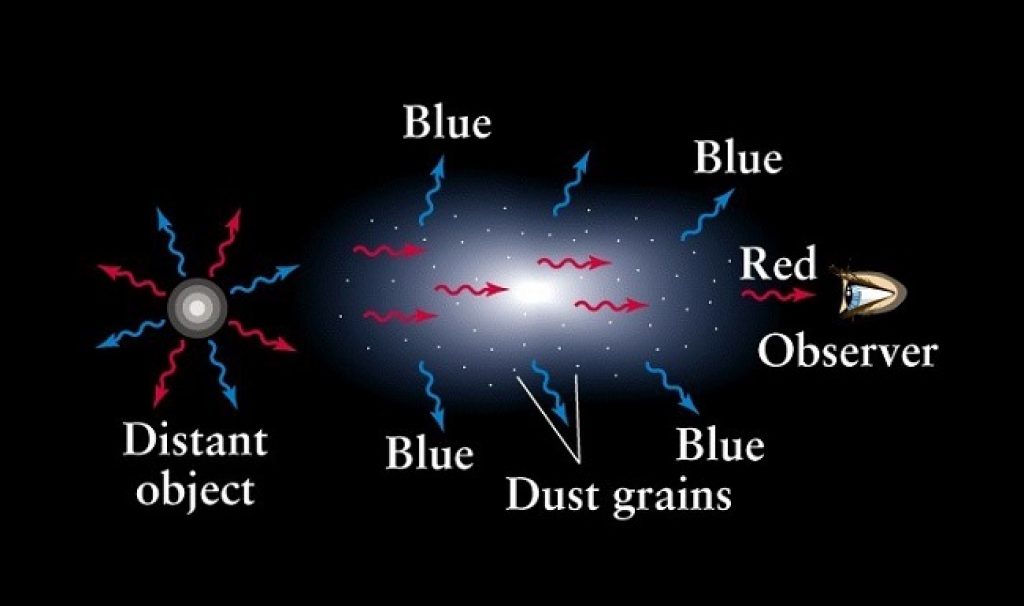
Cosmic dust—dust in space—includes intergalactic dust, interstellar dust, interplanetary dust and circumplanetary dust. It causes the scattering of electromagnetic radiation between the source and the observer, termed cosmic dust extinction. Because blue wavelengths of light are more affected by scattering, extinction causes objects to appear redder than they actually are.
The existence of cosmic dust could cause an apparent dimming of supernovae which as used as standard measurements, leading to an overestimation of the distance between them and affecting the estimation of cosmological parameters. However, it has been difficult to obtain an accurate estimate of the effect of cosmic dust using existing methods.
In the present study, a team of researchers led by professors Shen Shiyin and Shao Zhengyi from the Shanghai Astronomical Observatory and the University of the Chinese Academy of Sciences proposed a new estimation of the average cosmic dust extinction using a quasar continuum.
In this work, a large and homogeneous quasar sample from the Sloan Digital Sky Survey was selected and further divided into small bins of intrinsic luminosity and cosmic distance (redshift). After that, the possible reddening effects by the cosmic dust was checked.
“We found that in a fixed luminosity group, the quasar continuum becomes redder towards higher redshift,” Xie said. “This phenomenon is best explained by the cosmic dust extinction models after the other possibilities have been discussed.”
Commenting on the research, Shen said, “our results are globally consistent with the constraints of cosmic dust extinction from other independent measurements, and has reached to an unprecedented high cosmic distance (redshift z~3.2), which will be very helpful for the future cosmological studies.”
The article can be found at: Xie et al. (2015) An Apparent Redshift Dependence of Quasar Continuum: Implication for Cosmic Dust Extinction?
———
Source: Chinese Academy of Sciences.
Disclaimer: This article does not necessarily reflect the views of AsianScientist or its staff.