AsianScientist (Oct. 7, 2014) – The latest results from the Daya Bay Collaboration, an international group of scientists studying the subtle transformations of subatomic particles called neutrinos, have defined the limits of the mass of the elusive sterile neutrino, a possible new type of neutrino beyond the three known neutrino “flavors,” or types.
The existence of this elusive particle, if proven, would have a profound impact on our understanding of the universe, and could impact the design of future neutrino experiments. The new results, appearing in the journal Physical Review Letters, show no evidence for sterile neutrinos in a previously unexplored mass range.
There is strong theoretical motivation for sterile neutrinos. Unlike the three known types—electron, muon and tau neutrinos—it does not have the conventional weak interaction. Interacting only through gravity, the sterile neutrino is a popular candidate for the explanation of dark matter, the dominant form of matter in the universe.
Yet, the experimental landscape is unsettled; several experiments have hinted that sterile neutrinos may exist, but the others yielded null results. Having amassed one of the largest samples of neutrinos in the world, the Daya Bay Experiment is poised to shed light on the existence of sterile neutrinos.
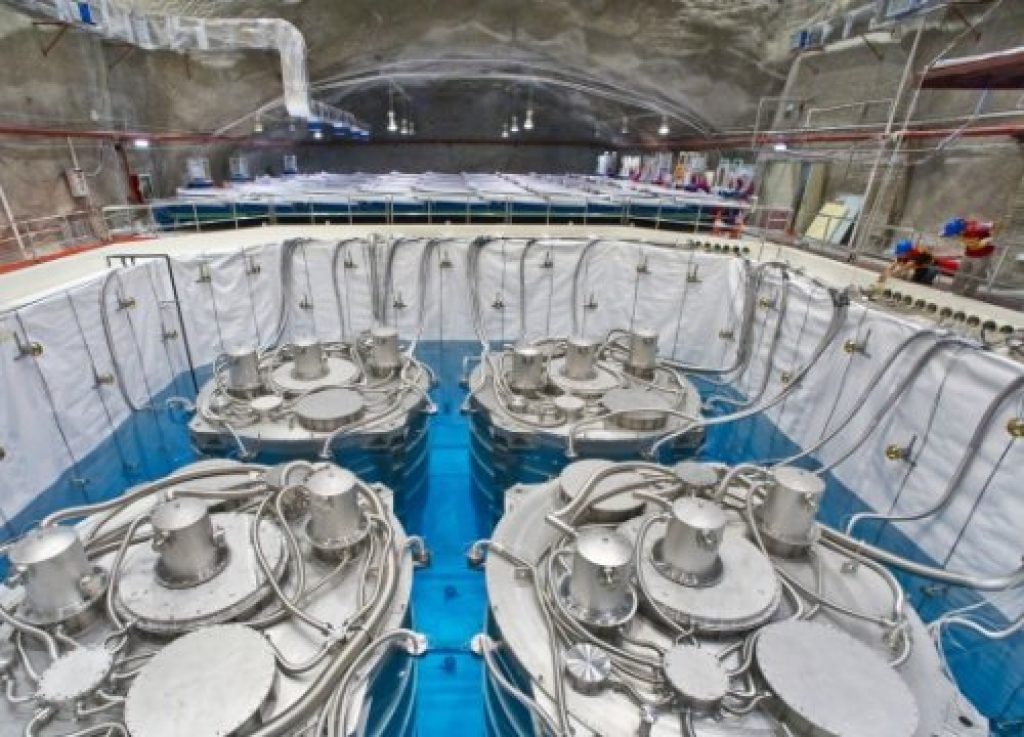
The Daya Bay Experiment is situated close to the Daya Bay and Ling Ao nuclear power plants in China, 55 kilometers northeast of Hong Kong. These reactors produce a steady flux of antineutrinos that the Daya Bay Collaboration scientists use for research at detectors located at varying distances from the reactors. The collaboration now has more than 200 scientists from six regions and countries including The University of Hong Kong and The Chinese University of Hong Kong.
“The Daya Bay experiment began its operation on December 24, 2011. Soon after, in March 2012, the collaboration announced its first results: the observation of a new type of neutrino oscillation—evidence that these particles mix and change flavors from one type to others—and a precise determination of a neutrino ‘mixing angle,’ called θ13, which is a definitive measure of the mixing of at least three mass states of neutrinos” says Dr. John K.C. Leung, one of the collaborators from The University of Hong Kong.
“These observations have led to the possibility that the electrically neutral, almost undetectable sterile neutrino could be a special type of matter and a very important component of the mass of the universe” says Dr. Jason C.S. Pun, another collaborator from The University of Hong Kong.
The new Daya Bay paper describes the search for sterile neutrinos by looking for the disappearance of electron antineutrinos produced from the reactors. If, like the known flavors, the sterile neutrino also exists as a mixture of different masses, it would lead to mixing of neutrinos from known flavors to the sterile flavor, thus giving scientists proof of its existence. That proof would show up as a disappearance of neutrinos of known flavors.
Within the searched mass range for a fourth possible mass state, Daya Bay found no evidence for the existence of a sterile neutrino.
This data represents the best world limit on sterile neutrinos over a wide range of masses and so far supports the standard three-flavor neutrino picture. Given the importance of clarifying the existence of the sterile neutrino, there are continuous quests by many scientists and experiments. The Daya Bay’s new result remarkably narrowed down the unexplored area.
The article can be found at: An et al. (2014) Search for a Light Sterile Neutrino at Daya Bay.
———
Source: The University of Hong Kong; Photo: Lawrence Berkeley National Laboratory.
Disclaimer: This article does not necessarily reflect the views of AsianScientist or its staff.