AsianScientist (Oct. 1, 2014) – “Bendy” light-emitting diode (LED) displays and solar cells crafted with inorganic compound semiconductor micro-rods are moving one step closer to reality, thanks to graphene and the work of a team of researchers in Korea.
Currently, most flexible electronics and optoelectronics devices are fabricated using organic materials. But inorganic compound semiconductors such as gallium nitride (GaN) can provide plenty of advantages over organic materials for use in these devices, including superior optical, electrical and mechanical properties.
One major obstacle that has so far prevented the use of inorganic compound semiconductors in these types of applications was the difficulty of growing them on flexible substrates.
In the journal APL Materials, a team of Seoul National University (SNU) researchers led by Professor Yi Gyu-Chul describe their work growing GaN micro-rods on graphene to create transferrable LEDs and enable the fabrication of bendable and stretchable devices.
“GaN microstructures and nanostructures are garnering attention within the research community as light-emitting devices because of their variable-color light emission and high-density integration properties,” explained Prof. Yi. “When combined with graphene substrates, these microstructures also show excellent tolerance for mechanical deformation.”
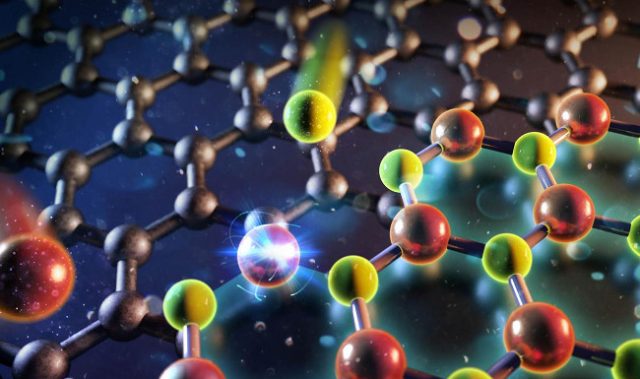
Why choose graphene for substrates? Ultrathin graphene films consist of weakly bonded layers of hexagonally arranged carbon atoms held together by strong covalent bonds. This makes graphene an ideal substrate “because it provides the desired flexibility with excellent mechanical strength, and it’s also chemically and physically stable at temperatures in excess of 1,000°C,” said Yi.
It’s important to note that for the GaN micro-rod growth, the very stable and inactive surface of graphene offers a small number of nucleation sites for GaN growth, which would enhance three-dimensional island growth of GaN micro-rods on graphene.
To create the actual GaN microstructure LEDs on the graphene substrates, the team uses a catalyst-free metal-organic chemical vapor deposition process they developed back in 2002.
“Among the technique’s key criteria, it’s necessary to maintain high crystallinity, control over doping, formation of heterostructures and quantum structures, and vertically aligned growth onto underlying substrates,” Yi says.
When the team put the bendability and reliability of GaN micro-rod LEDs fabricated on graphene to the test, they found that “the resulting flexible LEDs showed intense electroluminescence (EL) and were reliable; there was no significant degradation in optical performance after 1,000 bending cycles,” noted Chung Kunook, the article’s lead author and a graduate student in SNU’s Physics Department.
This represents a tremendous breakthrough for next-generation electronics and optoelectronics devices, enabling the use of large-scale and low-cost manufacturing processes.
“By taking advantage of larger-sized graphene films, hybrid heterostructures can be used to fabricate various electronics and optoelectronics devices such as flexible and wearable LED displays for commercial use,” said Yi.
The article can be found at: Chung et al. (2014) Growth and Characterizations of GaN Micro-rods on Graphene Films for Flexible Light Emitting Diodes.
——
Source: American Institute of Physics.
Disclaimer: This article does not necessarily reflect the views of AsianScientist or its staff.