AsianScientist (Jul 2, 2014) – Is ice always the same? A study published in the journal Nature Materials has shown that water can crystallize to an entirely new form of ice called Ice 0.
Up till now, only one form of ice was believed to be formed at pressures and temperatures commonly found on Earth. This ice, called Ice I, is the kind we commonly experience in our daily lives and that is found everywhere from snowflakes to glaciers.
The crystallization of water is a fundamental process in many natural environments (e.g. the atmosphere and inside biological systems) and technological settings (e.g. airline, food and energy industries). For example, the ice crystals that form in cirrus clouds play a major role in the Earth’s radiation budget and climate.
Despite its fundamental importance, ice crystallization is still poorly understood. Unlike most other liquids, water shows an array of mysterious properties that are unique in determining the conditions for the sustainability of life on Earth. One of the striking examples of this behavior is water’s ability to be supercooled without crystallizing. Pure water can in fact be cooled down to -40 degrees without turning into ice, as commonly found in atmospheric clouds, where water droplets can stay liquid despite the low temperatures of the troposphere.
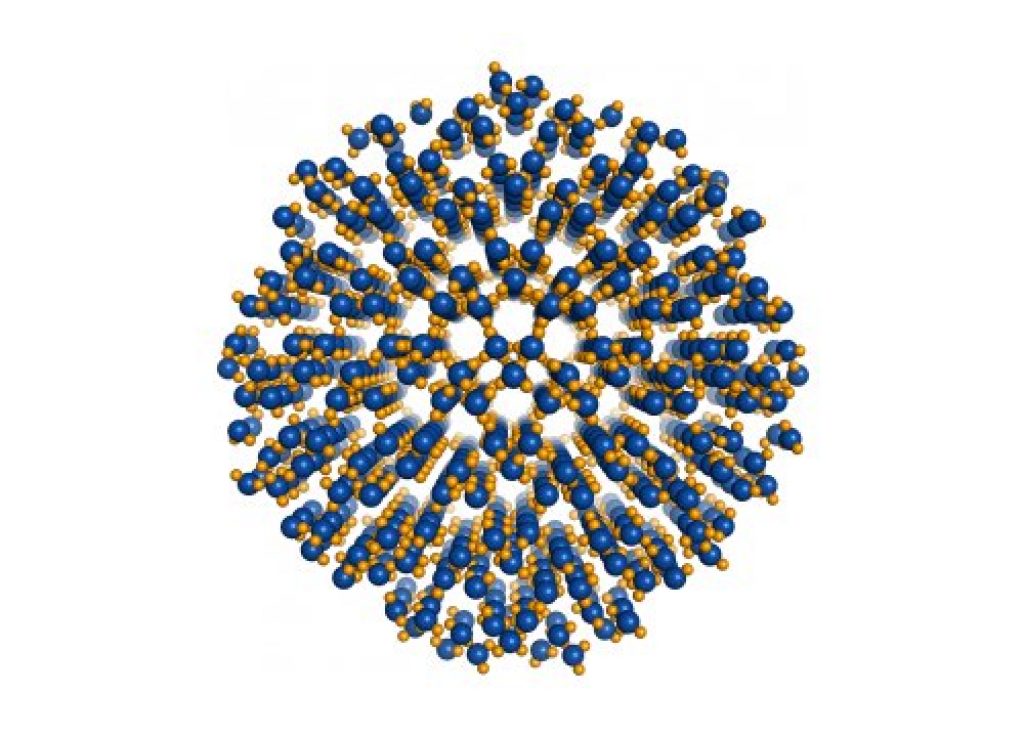
The new study by the research group of Professor Hajime Tanaka and Dr. John Russo at the Institute of Industrial Science, the University of Tokyo has found that at low temperatures water is unable to crystallize in the Ice I form, because the arrangement of the molecules is too dissimilar to what found in the liquid state. This is where the new Ice 0 form comes into play. Thanks to its similarity with the structure of supercooled water, the Ice 0 phase triggers the crystallization process, and then gradually converts into the common Ice I form as the crystals grow in size.
To verify this hypothesis, researchers have performed numerical simulations and showed that the Ice 0 form correctly explains the mysterious behavior of water under supercooled conditions. This discovery has the potential to radically change our knowledge of ice formation, the most important physical transformation on Earth.
The article can be found at: Russo et al. (2014) New Metastable Form of Ice and its Role in the Homogeneous Crystallization of Water.
———
Source: University of Tokyo.
Disclaimer: This article does not necessarily reflect the views of AsianScientist or its staff.