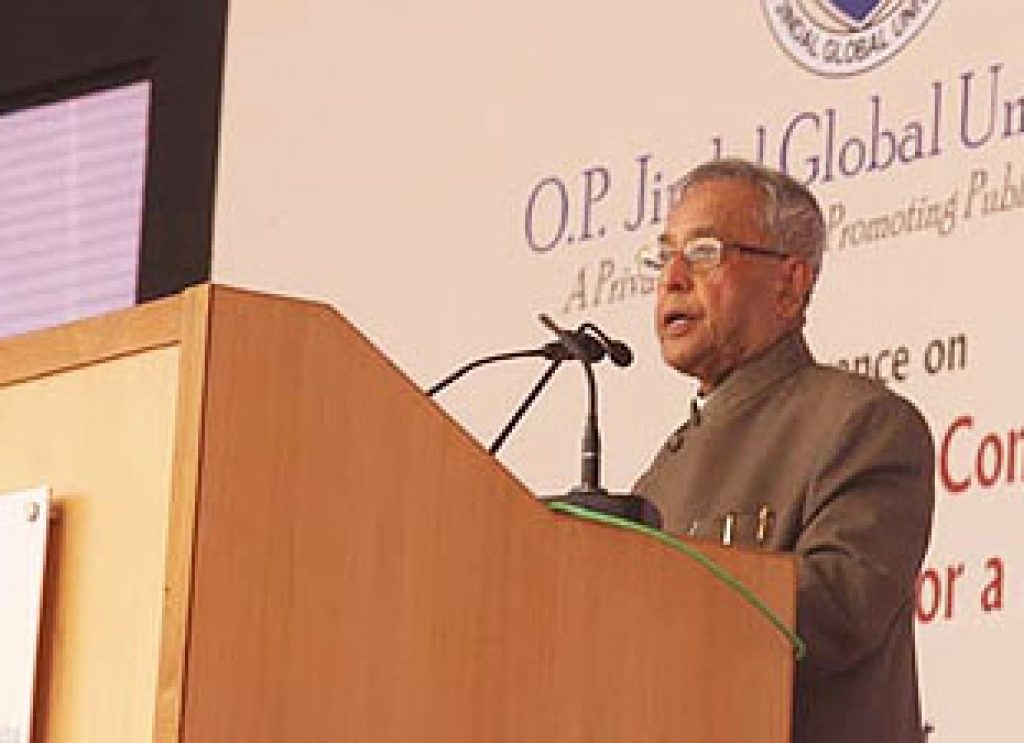
AsianScientist (Mar. 27, 2013) – Indian President Pranab Mukherjee on Thursday urged for more innovation in the country’s higher education sector.
He was in Haryana to inaugurate a conference on “The Future of Indian Universities: Comparative Perspectives on Higher Education Reforms for a Knowledge Society,” hosted by O.P. Jindal Global University in Sonipat.
Calling higher education the “most powerful tool that can spawn societal changes and transform the economic fortunes of a country,” President Mukherjee said there was an urgent need to “raise the quality of teaching, faculty, and research in our universities.”
He quoted Benjamin Franklin: “An investment in knowledge pays the best interest,” and paid homage to the Late Shri O.P. Jindal, a leading Indian industrialist in whose memory the university was established.
If India failed to harness the potential of her young population, it would lead to “terrible negative consequences,” he cautioned. Only around seven percent of those aged between 18-24 years receive higher education in India, compared to 21 percent in Germany and 34 percent in the United States, he said. Education should be made affordable to the marginalized through programs such as scholarships, education loans, and self-help schemes, he said.
Also concerning to the President was that not a single Indian university had been ranked in the top 200 based on the recent Times Higher Education World University Rankings 2012-2013.
“Ladies and Gentlemen, we lack universities that can provide quality education that meet global benchmarks. It is a matter of concern that there is not a single Indian university in the top 200 universities in the world as per an international survey of universities. This position is not at all acceptable. This calls for serious introspection. With educational standards that fall short of international benchmarks, India would be grievously handicapped in this competitive world,” he said.
He asked the Ministry of Human Resource Development, the University Grants Commission, and the universities to identify one department in every university that could be transformed into a Center of Excellence, and to address the shortfall of teachers in the university system.
President Mukherjee called on the private sector to play a larger role in India’s educational system.
“Some of the top universities of the world have been built on the initiative of the private sector. In India, the private sector has left its mark in several key sectors like health, transport and financial services. I see no reason why the Indian private sector cannot replicate its efforts in the higher education sector as well. But, care should be taken to ensure that there is no dilution in educational standards,” he said.
Innovation should also be emphasized, he said. Currently, although Indians represent about 17 percent of the global population, only two percent of the patent applications in the world in 2011 were filed in India, he said. In the same year, only 42,000 patent applications were filed in India compared to the 500,000 patent applications in China and the United States, he said.
“Cross-fertilization” of ideas and knowledge could also be achieved by inviting Indian scholars working overseas in important research and teaching positions to take up short-term assignments in Indian universities, he said.
Finally, universities need to mentor young innovators at the grassroots level, and help these young risk-takers take their inventions into the commercial market, he said.
“Universities and Research Centers should become fertile grounds for innovation. Setting up industry incubation parks, enhancing the coverage of research students by fellowships, promoting inter-disciplinary research through inter-university and intra-university collaboration, and empowering our centers of excellence would be important steps in this direction,” he said.
——
Copyright: Asian Scientist Magazine.
Disclaimer: This article does not necessarily reflect the views of AsianScientist or its staff.