AsianScientist (Nov. 25, 2015) – Picture the young mathematician, a recent Stanford University graduate, among a pioneer batch of Singaporean scholarship holders who have returned home to teach.
In the early 1970s, the University of Singapore is a quiet academic backwater, not the bustling campus with the tens of thousands of local and international students it has today. Laboratories are rudimentary. The Internet does not yet exist and postal services are slow—by the time a journal or book arrives in the university library, it is already out of date. Funds for travel to mathematics powerhouses in Europe and the US are meagre.
But pure mathematics is part of the life of the mind, limited not by technology but only by one’s imagination and work ethic. Thus the young mathematician, who lectures in the day and works on his doctoral thesis at night, publishes in 1975 a seminal paper in a relatively new field—a new method for understanding the probability that rare events will occur.
The paper will give rise to a new area in discrete probability, with applications in many fields including computational biology, epidemiology, economics and computer science.
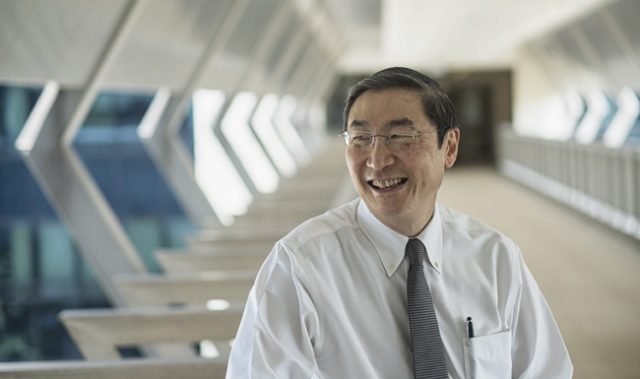
This is the life and work of Louis Chen, 74, distinguished professor of mathematics and statistics at the National University of Singapore (NUS). In the 43 years he has been there, NUS’s mathematics department has climbed from the doldrums into the world’s top-20-ranked programmes.
A sequence of rare events
Professor Chen almost missed out on Stanford University. He had applied for the US’s Fulbright-Hays Program, which gave students travel grants for their PhDs, and was offered a scholarship to either Adelphi University or Ohio State University.
To meet the looming acceptance deadlines, Professor Chen thus accepted the Ohio State offer before the other schools he had applied to—Stanford and the University of California, Berkeley—had responded. Then came a fateful phone call from the office in Kuala Lumpur that administered the Fulbright-Hays Program.
“Congratulations Mr Chen,” the administrator said. “You have got an offer of scholarship from Stanford University!” The admission would prove fortuitous not only for Professor Chen, but the whole mathematics world.
At Stanford, keen on pure mathematics, he had hoped to complete his thesis on probability theory with Rupert Miller, the department’s chairman. But Professor Miller referred him to Charles Stein, a mathematical statistician, who had just come up with a novel idea in probability—a new way of proving the central limit theorem, a fundamental theorem that says that enough random observations will be distributed according to a normal distribution, the classic “bell curve”.
Professor Stein was the quintessential brilliant mathematician.
“He’s the sort of person who goes to the lecture room to talk about his latest ideas, and gets stuck halfway,” Professor Chen says. “He’d tell us to come back next week, but be talking about something else altogether the following week. But we heard his latest ideas. It was a goldmine.”
Professor Chen’s eventual research—applying the so-called “Stein’s method” to Poisson distributions as probability approximations for the occurrences of rare events—would be published in 1975.
But its real impact would come years later. In the 1980s Persi Diaconis, a Stanford probabilist, brought the research to the attention of computational biologists. They soon realised its applicability to sequence comparison in bioinformatics and began calling the new formula the Chen-Stein method.
DNA sequences, which encode the biological instructions for building an organism, can consist of millions of pairs of “letters”—the chemical building blocks adenine, thymine, cytosine and guanine (commonly known as: A, T, C and G). By comparing two sequences and using the Chen-Stein method to work out whether their similarities are due to mere chance or something more fundamental, scientists can make inferences about the sequences’ biological functions.
One component of sequence comparison is the calculation of p-values, a probability function for a particular sample. Before biologists discovered the Chen-Stein method, they calculated the p-value through the relatively tedious inclusion-exclusion formula.
The Chen-Stein method offers a simpler formula for calculating p-values; as a corollary of that, it provides a theoretical basis for the Basic Local Alignment Search Tool (BLAST), an algorithm that is used widely in sequence searching and comparison.
In short, by helping to speed up sequence comparison, the Chen-Stein method has been a boon for computational biology and genomics.
How might one researcher stumble into work that will become highly influential years down the road, and another researcher end up in a cul-de-sac?
It is fate, Professor Chen believes. Although his professional end-point was not obvious initially, he now believes that each step in his life somehow guided him towards it.
Early life
Born on the eve of the Japanese Occupation to immigrant parents from Chaozhou, Guangdong, Professor Chen was the second of seven children.
During the war his father, a primary school principal, became a vegetable seller in order to escape the infamous Sook Ching: Japanese purges of intellectuals, particularly teachers and journalists, who were thought to harbour anti-Japanese sentiments.
After the war, Professor Chen attended Catholic High School and St Joseph’s Institution. From an early age, he was keen on mathematics and physics.
“I wanted to do physics, because there was no Nobel Prize in mathematics, but in the end I found that my first love was still mathematics,” he says.
He also liked music, and continues today to play he recorder—not the squeaky plastic device played by children, but a sleek professional woodwind.
“One fortunate thing was that all of us could study,” he says. “We could get good grades.”
Unusual for an eldest son at the time, his parents did not pull him out of school to support the family.
Professor Chen’s teachers were also encouraging. Sheng Chen Kuo, a Marist Brother, nudged along the nascent talent, entering him into inter-school mathematics competitions, which he won thrice. Meanwhile, popular science books such as One, Two, Three… Infinity by George Gamow, a physicist, captured his imagination with simple, entertaining explanations of the concepts of infinity, exponential growth and topology.
But Professor Chen could not afford to go to university. Fortunately, his grades earned him
a prestigious state scholarship to the University of Singapore. He graduated in 1964 then left for Stanford.
And in perhaps the most important chance event of all, Professor Chen met his wife-to-be in the library at Stanford while looking for reference material. Today they have two daughters and two granddaughters.
Nurturing Singapore mathematics
Upon Professor Chen’s return to Singapore in the 1970s, he remained focussed on his research, driven by ambition and a good work ethic, imbibed at Stanford.
“I was working in an area which was the beginning of a field,” he says. “When you work in the beginning of a field, there are always problems you can solve; there are many open questions to tackle.”
As the university’s lone probabilist and statistician, and one “not shy to express opinions about things”, he was often shepherded into administrative roles, such as head of the mathematics department, head of the statistics and applied probability department, and eventually director of the university-level Institute for Mathematical Sciences, which promotes research interaction between local and foreign mathematicians.
The institute also organises research programmes, conferences, workshops, and academic and public talks in mathematics; the subjects of these range from the highly theoretical to those directly relevant to various fields such as finance, epidemiology and computing.
NUS’s mathematics department has grown from fewer than 15 faculty members in the 1970s to more than 70 today. It is also globally renowned—at the last International Congress of Mathematicians, a kind of world summit of mathematics held every four years, four of its members were among the 200 or so invited to give lectures.
Unsurprisingly, Professor Chen agrees with the Singapore school curriculum’s emphasis on mathematics.
“Mathematics is so fundamental to science that everybody should have some understanding of it,” he says.
As for research, “the mathematics community as a whole understands that we have to continuously move up, to continuously get better,” he says. Mentoring individual students, passing on a passion for mathematics, and being role models can help make the difference in inspiring students to pursue graduate studies and become mathematicians themselves, Professor Chen adds.
Retirement plans
Even though Professor Chen plans to retire in 2015 from administrative and teaching duties, he is nowhere near done with research.
In particular, he plans to study the connections between Stein’s method and other branches of mathematics, such as number theory, which includes problems involving prime numbers.
Another branch is a species of non-Newtonian calculus called Malliavin calculus. While conventional calculus is the study of change for functions of the real number, Malliavin calculus studies change for functions of normally-distributed random variables, i.e. those exhibiting a bell-shaped distribution.
And while other researchers may use computer models to simulate their results, Professor Chen says he could work on a couple of blackboards if need be.
“In the past, we did not have the environment that young people enjoy today—the Internet, funds for travel, and so on,” says Professor Chen. “And for many years I was always involved in some sort of administration. So now the time has come for me to do the things I am really interested in without distractions. I’m really looking forward to it.”
This also includes indulging in hobbies such as travel and music, and spending time with his peers. In 2000, friends and colleagues organised a mathematics conference to mark Professor Chen’s 60th birthday. Ten years later, they outdid themselves with an even bigger conference, with more international invited speakers.
In a lifetime of rare events, it appears some traditions still have a comforting predictability.
This feature is part of a series of 25 profiles, first published as Singapore’s Scientific Pioneers. Click here to read the rest of the articles in this series.
———
Copyright: Asian Scientist Magazine; Photo: Cyril Ng.
Disclaimer: This article does not necessarily reflect the views of AsianScientist or its staff.