


The Asian Scientist 100
Long Ran

Institution
University of Science and Technology of China
Country
China
Field
Chemistry
Long won the 2017 L’Oréal UNESCO For Women in Science International Rising Talent award for her research on photocatalysts for carbon dioxide reduction.
(Photo: L’oréal Foundation)
AWARDS
- 2017 LOréal-UNESCO For Women in Science International Rising Talent Award
Related articles

India’s Hearing Impaired To Receive Boost From New Sign Language Research Center
India's three million hearing impaired population will receive training and support from a newly established sign language center in New Delhi.

WWF-India Initiates Study To Protect Tigers In Nandhor Valley
WWF-India has initiated a study of Nandhor Valley, with the two priority corridors of Kilpura-Khatima and Boom-Bhramdev, as a protected breeding area for endangered tigers.

Study: Fluorescent Lighting May Increase Eye Disease, Cataracts, Pterygia
The use of fluorescent lighting instead of incandescent ones as a strategy to beat climate change could be increasing eye disease, says a new study.

World’s Largest Supergiant Prawns Sighted In New Zealand’s Kermadec Trench
Scientists aboard the RV Kaharoa have discovered 'supergiant' prawns in New Zealand's Kermadec Trench that are 28 centimeters long and 10 to 14 times larger than regular prawns.

Chinese T. Rex Discovered In Eastern China
T. Rex's long lost cousin may have just been discovered in China.

Male Bottlenose Dolphins Use Social Networks To Secure A Mate
New research shows that male dolphins who form social alliances have better reproductive success than those who go solo.
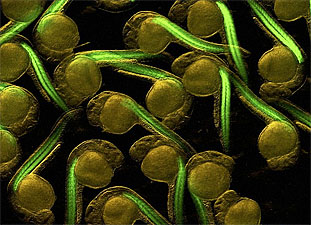
Researchers Visualize Retinoic Acid Gradient In Live Embryo
Researchers in Japan have developed a new technique that enabled them to visualize the distribution of retinoic acid in a live zebrafish embryo, in real-time.

How Do We Feed India’s Population In 2050?
The average Indian consumes only 2,300 calories per day - below the poverty level of 2,400 calories a day. The trend in recent years is for Indians to eat even less, writes Ranjit Goswami.

China To Launch Earth Observation Satellite This Month
China is planning to launch a high-resolution Earth observation satellite this month.