


The Asian Scientist 100
Chang Tse Wen
Distinguished Visiting Chair
Institution
Academia Sinica
Country
Taiwan
Field
Biomedical Sciences
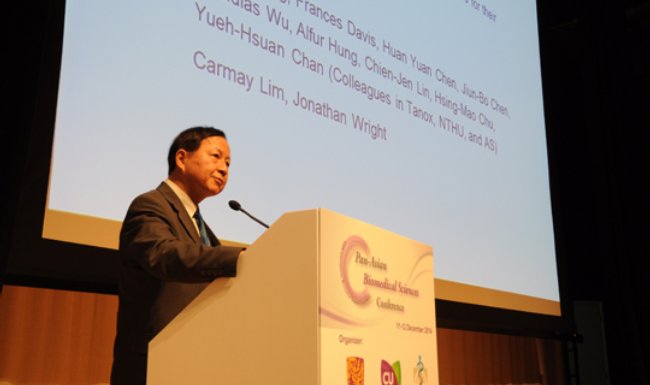
Chang received The World Academy of Sciences 2014 prize in medical sciences for developing treatments for asthma.
(Photo: Chinese University of Hong Kong)
Related articles

Celebrating Excellence in Asia With The Asian Scientist 100
These rising stars and veterans hail from diverse sectors in industry and academia, but they all share in one common mission—to make tomorrow a better place for you and me.

Thriving In An Uncertain World
A culture of innovation is needed for Singapore to shine, says SMU President Professor Arnoud De Meyer, speaking at the SMU Behavioural Sciences Institute's recent conference on 'Unintended Consequences in Singapore'.

The Ancient Origins Of East Asian Ancestry
Modern day East Asian populations living in the Amur Basin can trace their ancestry to Stone Age hunter-gatherers who lived in the same area nearly 8,000 years ago.

Malaria’s Best Defense Is Also Its Achilles’ Heel
Mutations to a protein that enables the malaria parasite to evade several anti-malarial drugs can make it vulnerable to other drugs, a study has found.

Meet China’s First Biotech Unicorn
Why did Wang Jun, CEO of one of the world’s largest DNA sequencing companies, leave to join an artificial intelligence startup? Simple: to start something even more ambitious.

Antibiotics: A Remedy In Decay?
The Golden Age of Antimicrobials is over. Our fight against the deadly, multi-drug resistant bacteria that threatens our lives will thus have to resume.

China Leads The World In Pharma Innovation: Report
Thanks to a strong emphasis on public-private partnerships and scientific research, China is now the world's leading region in pharmaceutical innovation.

Zika, The Suddenly Famous Disease
When epidemics spread, so will misinformation. How do you cut through all of the noise? One way is to be more critical of what you read online.

Stay Eternally Optimistic, Says Nobel Laureate Ei-ichi Negishi at GYSS@one-north 2016
Believe it or not, before Ei-ichi Negishi became a Nobel Prize-winning organic chemist, he was a farmer.