AsianScientist (Aug. 28, 2017) – Scientists in Japan have identified the protein that determines the position of hindlimb development in the embryos of vertebrates. They report their findings in the journal Nature Ecology & Evolution.
The term tetrapods literally translates as ‘four feet’ and is usually used in reference to animals that have two front limbs and two hindlimbs. However, it also includes all the organisms, living and extinct, that descended from the last common ancestor of amphibians, reptiles and mammals, even if they have lost their four feet over the course of evolution. Hence, animals such as snakes and birds are also considered tetrapods.
The position of hindlimbs in tetrapods has diversified according to the number of small bones forming the spine. Although scientists have been studying tetrapod anatomy for years, it remains unclear how hindlimb position is determined during embryonic development.
In this study, researchers from Nagoya University in Japan have demonstrated that a protein called GDF11, which is involved in embryonic development, plays a vital role in the eventual position of the sacral vertebrae and the hindlimbs.
“In laboratory mice that do not produce the protein GDF11, we have noted that the sacral vertebrae and the hindlimbs are shifted more to the back,” said Professor Yoshiyuki Matsubara of Nagoya University.
The research team started by analyzing the expression pattern of the gene of interest and examining the relationship between the pattern and the prospective position of the spine and hindlimbs at different development stages in chicken embryos. They then demonstrated that hindlimb positioning could be manipulated by changing the timing of GDF11 activity in the embryos.
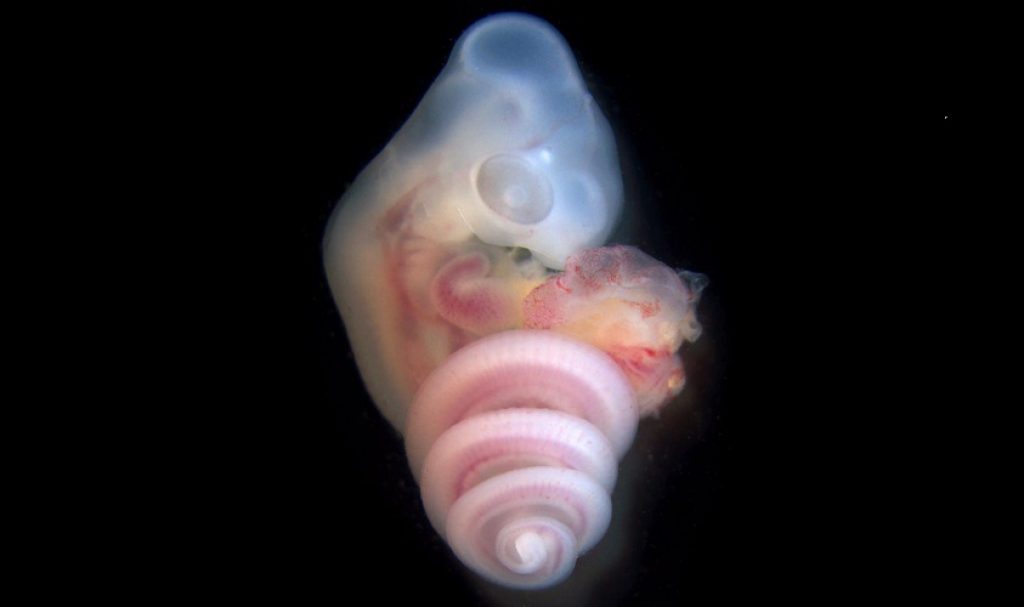
Lastly, to fully elucidate the role of GDF11 in diversification of the hindlimb position in tetrapods, the team examined the correlation between GDF11 expression and hindlimb positioning in eight tetrapod species, including the African clawed frog, Chinese soft-shelled turtle, ocelot gecko, Japanese striped snake, chick, quail, emu and mouse. They found that snakes have a long trunk because GDF11 expression occurs much later in the developmental stage than in other tetrapod species.
“Our results suggest that species-specific hindlimb positioning may have been an effect of the change in the timing or rate of GDF11 expression during embryonic development,” said Associate Professor Takayuki Suzuki who was involved in the study.
Their observations will allow researchers to propose a model to explain the coupling of sacral-hindlimb positioning in tetrapod evolution. This will lead to a deeper understanding of the diversification of lineage-specific tetrapod hindlimb positions.
The article can be found at: Matsubara et al. (2017) Anatomical Integration of the Sacral–hindlimb Unit Coordinated by GDF11 Underlies Variation in Hindlimb Positioning in Tetrapods.
———
Source: Nagoya University; Photo: Takayuki Suzuki.
Disclaimer: This article does not necessarily reflect the views of AsianScientist or its staff.