AsianScientist (Apr. 15, 2016) – In this age of ultra-connectedness, we are constantly surrounded by smart displays—on mobile phones, laptops, tablets and medical devices. So why not make it a part of our bodies?
Researchers in Japan have developed an ultra-thin, flexible e-skin that has a organic light-emitting diode display on it—bringing us that much closer to becoming one with our gadgets. Their technology, described in Science Advances, could potentially be used for medical applications such as displays for blood oxygen concentration or pulse rate—giving whole new meaning to wearing your heart on your sleeve.
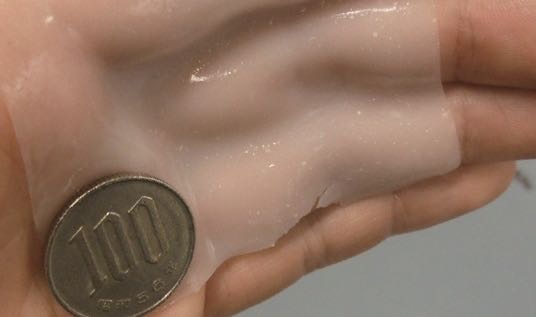
The team from the University of Tokyo developed the protective film by alternating layers of inorganic and organic material—silicon oxynitrite and parylene respectively. The result is a high-quality protective film, that can be incorporated into ultra-thin, ultra-flexible, high performance wearable electronic displays and other devices.
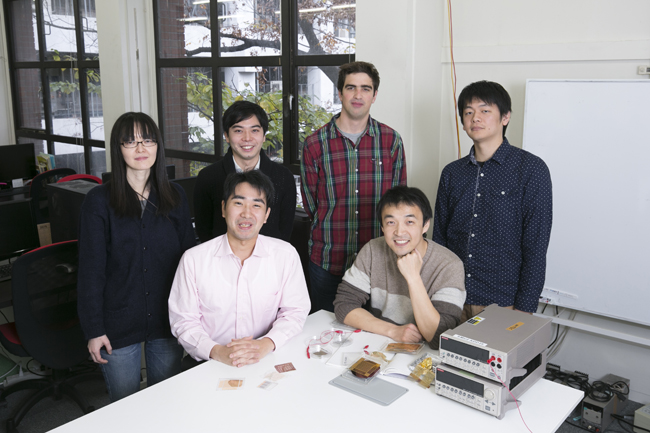
The protective film, by the research group of Professor Takao Someya and Dr. Tomoyuki Yokota from the Graduate School of Engineering, was found to be more hardy than in prior research, extending device lifetimes from a few hours to several days.
In addition, the research group was able to attach transparent electrodes to the fragile film without damaging it, making the e-skin display possible.
The total thickness of the device, including the substrate and encapsulation layer, is only 3 micrometers—ten times thinner than the epidermal layer of human skin. Because of how thin it is, developing this e-skin was not without its challenges, according to the researchers.
“The most difficult point was to make a high quality photonic device on an ultra-thin substrate. We tried to overcome this problem by optimizing the fabrication process,” corresponding author Dr. Tomoyuki Yokota from the Someya Group at the School of Engineering told Asian Scientist Magazine.
“We found the planarization layer is very important to form a very flat indium tin oxide (ITO) electrode.”
Planarization refers to the process of smoothing surfaces with the combination of chemical and mechanical forces.
Using the new protective layer and ITO electrodes, the research group then created polymer light emitting diodes (PLEDs) and organic photodetectors, which made up the light display. These were thin enough to be adhered to the skin and flexible enough to distort and crumple in response to body movement.
As the e-skin was found to be over six times more efficient than previously reported ultrathin PLEDs, this made it ideal for direct attachment to the body. The research group even experimented with combining red and green PLEDs with a photodetector to create a blood oxygen sensor.
“The advent of mobile phones has changed the way we communicate. While these communication tools are getting smaller and smaller, they are still discreet devices that we have to carry with us,” said Someya in a press release.
“What would the world be like if we had displays that could adhere to our bodies and even show our emotions or level of stress or unease?”
As it is, it seems the future holds exciting things for their device. According to Yokota, they intend to try to make a full color display.
“If we succeed, we can apply our technology to many kinds of applications,” he said.
The article can be found at: Yokota et al. (2016) Ultraflexible organic photonic skin.
———
Copyright: Asian Scientist Magazine; Photo: Someya Laboratory.
Disclaimer: This article does not necessarily reflect the views of AsianScientist or its staff.