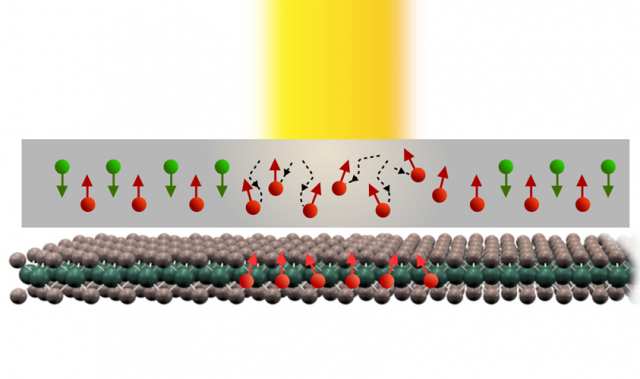
AsianScientist (Apr. 14, 2016) – Researchers in Singapore may have achieved a breakthrough in magnetic interaction. By adding a special insulator, they can make electrons ‘twirl’ their neighboring ‘dance partners’ to transfer magnetic information over a longer range between two thin layers of magnetic materials. This technique enables magnetic information to make their way from one magnetic layer to another, synonymous to the encoding and transmission of data.
The findings, by a research team from the National University of Singapore’s Nanoscience and Nanotechnology Institute (NUSNNI), were reported in Nature Communications.
While many people are used to downloading data from the Cloud onto mobile devices, most do not know where the data comes from. Digital information is stored in minute magnetic dots written in layers that are only a few nanometers thick. These layers of magnetic dots cover the surface of millions of saucer-sized spinning disks. These hard disks are stacked by the thousands in server farms worldwide.
In recent years, we have succeeded at perfecting the technology for developing uniform magnetic layers only ten to 100 atoms thick. By combining them into complex stacks, these nanostructures form the foundation of ‘spin electronics.’ The ‘spin’ here refers to the resemblance between the electron and a spinning ball of electric charge; the spin turns the electron into a tiny magnet.
When two magnetic layers are stacked close to each other, they couple together to exchange electrons with each other. The electrons carry across their spin, and the directions of magnetization of the two layers are aligned. This coupling is broken if the two magnetic layers are separated by an insulating spacer that is more than a few atoms thick, which the free electrons cannot penetrate.
As magnetic interactions are normally mediated by short-range exchange or weak dipole fields, the research team sought to propagate the magnetic interaction over longer distances.
First author, research fellow Dr. Lü Weiming, found that the use of a polar oxide insulator enables the range of magnetic coupling to jump from about one nanometer to ten, and its strength varies up and down with insulating spacer thickness. This discovery is significant, as it was originally thought that no electrons could ever make their way across this impenetrable layer.
To explain this unusual observation, visiting faculty at NUSNNI, Professor Michael Coey, came up with a possible theory: “Instead of spin magnetism being carried across directly by messenger electrons, it is the orbital magnetism that is passed along from one atom to the next across the insulator. The atomic electrons are engaged in a dance, each twirling their partners on the neighboring atoms until the orbital motion reaches the other side.”
Coey’s supposition was proven to be true by research team member Dr. Surajit Saha, who performed spectroscopic measurements on the new magnetic effect.
Now that the research team has provided the recipe for the insulator that allows the magnetic effect to occur, they intend to further investigate the effect to fully understand the mechanism, and to develop a new generation of magneto-optical devices.
“The recent discovery by our team paves the way for the development of devices that operate in the terahertz frequency range, which makes encoding and transmission of data many times faster,” explained team co-leader Assistant Professor Ariando.
The article can be found at: Lü et al. (2016) Long-Range Magnetic Coupling Across a Polar Insulating Layer.
———
Source: National University of Singapore.
Disclaimer: This article does not necessarily reflect the views of AsianScientist or its staff.