AsianScientist (Mar. 30, 2016) – A study published in PLOS ONE has found that maintaining even the tiniest wildlife sanctuaries will help preserve some biodiversity in increasingly urbanized landscapes.
The researchers from the Center for Ecological Sciences at the Indian Institute of Science, Manipal University, Center for Wildlife Studies and the Wildlife Conservation Society (WCS)-India say their findings could have important implications in future land-use, particularly in rapidly urbanizing regions where some wildlife still persist.
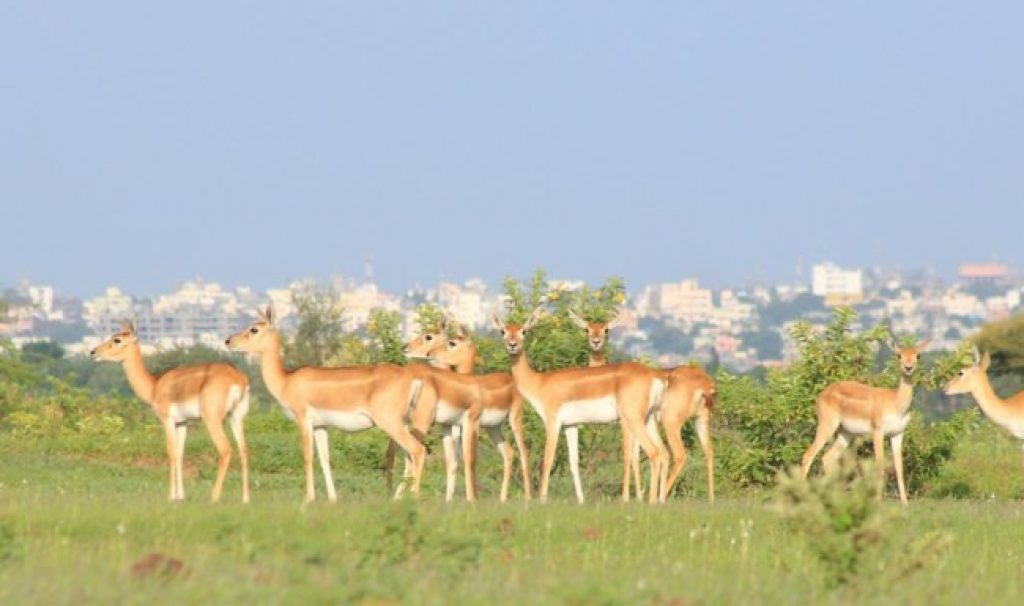
The researchers looked at populations of blackbuck—a near threatened species of antelope—in and around the Great Indian Bustard Sanctuary in Nannaj, Maharashtra in south-central India. Increasing encroachment by humans has fragmented grasslands into plantations, grazing areas and agricultural lands. The landscape is densely populated by humans and cattle and is representative of most semi-arid landscapes in India.
Researchers measured the amount and quality of grass, the major blackbuck food source, and identified risky areas, where blackbuck were most likely to come across wolves, dogs or humans. They found that blackbuck preferred to stay in the safety of the sanctuary when food was abundant to avoid the risks associated with humans and livestock.
But as food declined after the monsoon season, blackbuck began to move into riskier unprotected grasslands, thus responding dynamically to seasonally changing levels of food and risks in the different parts of the landscape.
This study finds that the presence of small sanctuaries or ‘refuges’ in densely populated semi-arid landscapes allows these antelopes to survive, and provides clues as to why animals might be moving outside sanctuaries. A desperate search for food could thus be leading blackbuck to make seasonal changes in their movements and venture into more risky areas located outside the sanctuary.
These factors need to be taken into consideration as more grasslands are converted and developed for human use. This study shows that coexistence of conservation and development is possible, provided that wildlife are offered refuges, such as the small protected areas that constitute the Great Indian Bustard Sanctuary.
The article can be found at: Krishna et al. (2016) Wild Ungulate Decision-Making and the Role of Tiny Refuges in Human-Dominated Landscapes.
———
Source: Wildlife Conservation Society.
Disclaimer: This article does not necessarily reflect the views of AsianScientist or its staff.