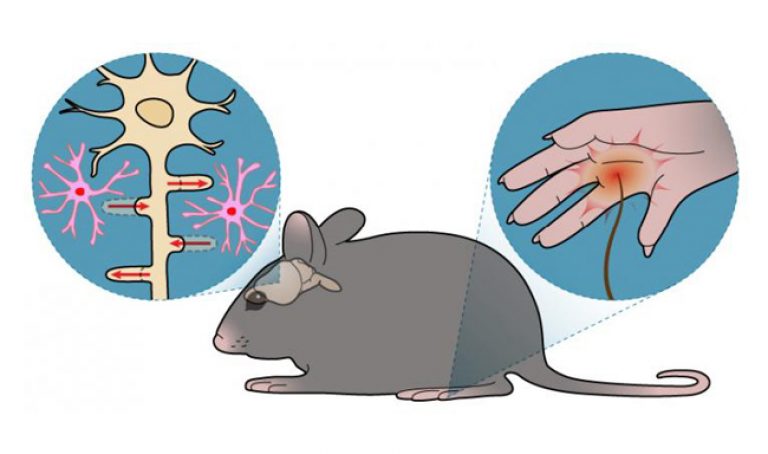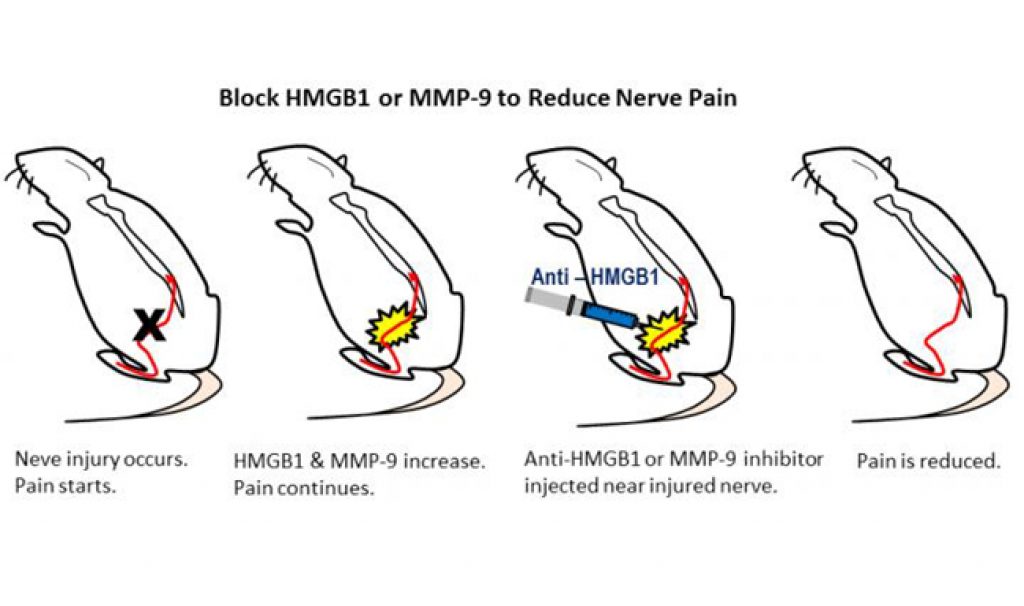
AsianScientist (Mar. 8, 2016) – Japanese researchers have succeeded in identifying and blocking a specific molecule involved in prolonging pain after a sciatic nerve injury in mice. These results reveal a promising therapeutic strategy for treating neuropathic pain. Their work was published in Journal of Neurochemistry.
Sciatic nerve pain, or sciatica, causes pain in the lower back, buttocks or back of the leg, and is often caused by a herniated disc in the spine or a pinched nerve. Similar pain can occur in different nerves in patients with cancer or diabetic neuropathy.
Mice with an injury to their sciatic nerve showed less pain after multiple injections of a drug that blocks the activity of a molecule called high-mobility group box-1 (HMGB1). The Hiroshima University researchers also discovered that a single dose of a drug to block the activity of a different molecule, called matrix metalloprotease-9 (MMP-9), could also alleviate pain from the injury.
The chemical pathways that these drugs use to inhibit HMGB1 or MMP-9 are different from the active ingredients in common pain relievers, like the opioids in morphine or acetaminophen in Tylenol. Therefore, the potential for addiction or negative side-effects may be reduced.
The results reveal that the drug to block HMGB1, called anti-HMGB1, has the downstream effect of preventing the increase of MMP-9 that would normally be expected when HMGB1 increases. Therefore, an inhibitor of MMP-9 may be a more direct route to produce the same effect. This is the first study to link HMGB1 and MMP-9 together in the cellular process of pain management.
The research team, led by Professor Yoshihiro Nakata at Hiroshima University’s Institute of Biomedical and Health Sciences, demonstrated a pain-relieving effect from injecting anti-HMGB1 into the hip of mouse models.
Furthermore, blocking HMGB1 lessened pain with no negative impact on healing. Selectively blocking MMP-9 also relieved pain with no obvious changes to the activity of other molecules responding to the injury.
The results of this study show promise for relieving nerve pain with a chemically specific approach that is convenient for patients.
The article can be found at: Zhang et al. (2015) Perineural Expression of High-mobility Group Box-1 Contributes to Long-lasting Mechanical Hypersensitivity via Matrix Metalloprotease-9 Up-regulation in Mice with Painful Peripheral Neuropathy.
———
Source: Hiroshima University.
Disclaimer: This article does not necessarily reflect the views of AsianScientist or its staff.