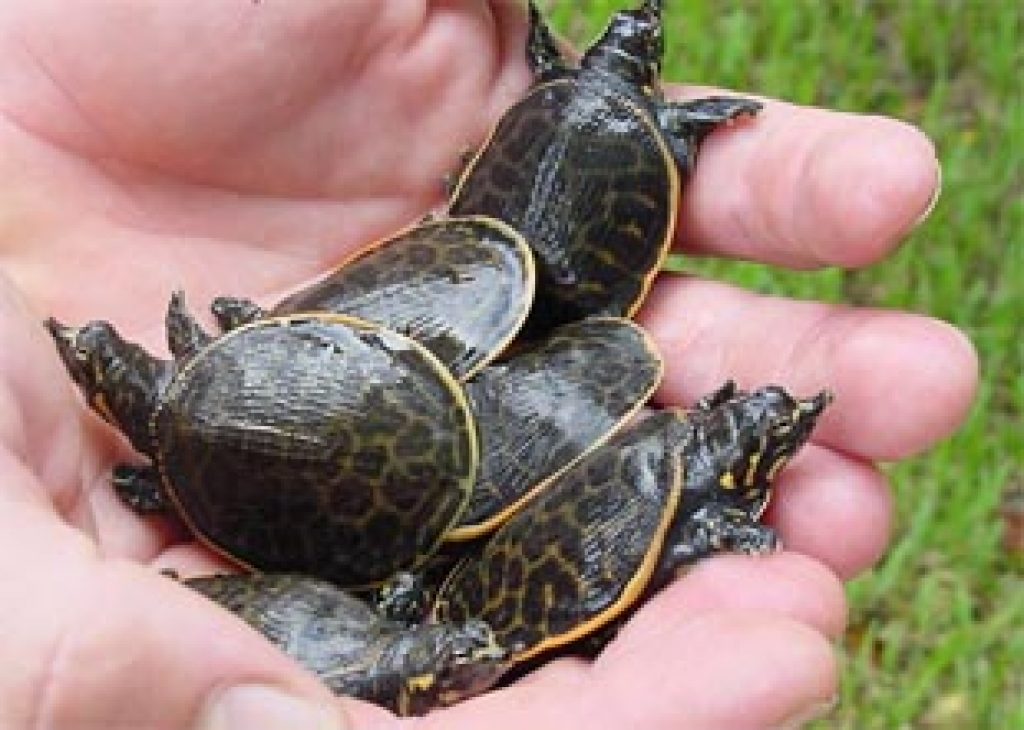
AsianScientist (May 24, 2011) – Many animals, including the majority of reptiles, cannot produce their own body heat. To control their temperature, they bask in the sun to heat up and lounge in the shade to cool down. However, it was assumed that the embryos of soft-shelled turtles – trapped within an immobile egg and lacking motor structures – would lack that ability to move.
Surprisingly, Wei-Guo Du and colleagues at the Institute of Zoology, Chinese Academy of Sciences found that the embryos can not only move, but they can even snuggle up to the warmest side of their eggs.
Du collected 260 eggs from a local turtle farm, placed them in individual jars and warmed them with heat lamps. The eggs were about one degree Celsius warmer on the sides closest to the lamps, and the turtles could sense this. After a few days, they had pressed up against the warmer side. When Du moved the heat lamps around, the embryos followed.
Du also buried 540 eggs in more natural nests, either in a flat field or a sloping river bank. By shining a candle on the eggs and observing the silhouette, he arranged all the eggs so the embryos were sitting in the uppermost half of the egg. After 20 days, those which were warmed by the sun from directly overhead stayed in the same position. However, embryos which were buried on the slope, with the sun shining down on them at an angle, shifted towards the bank.
So what is the significance of this observation in nature?
A small difference in temperature can mean the world to a developing turtle. It can affect how quickly it grows, how big it gets, and when it hatches. Heat a turtle embryo up by one degree – the temperature difference Du used in his study – and it will hatch around 4.5 days earlier. That’s nearly five days where it will not be a sitting duck for egg predators, temperature extremes or drought.
Mother turtles also bury the eggs in underground nests which have uneven temperatures – some eggs will be warmer than others and some parts of each egg will be warmer than other parts. Soft-shelled turtle embryos can sense these differences and respond to them via microscale movements.
“The embryo is not simply a work in progress, but is a functioning organism with surprisingly sophisticated and effective means of affecting its own destiny,” said Du.
This discovery raises a tantalizing possibility that reptiles may be able to control their own sex. For many reptiles, the temperature of the egg determines the sex of the babies. In some turtles, if eggs are incubated at 22.5 to 27 degrees, the babies will be all male. Incubated at 30 degrees and they will all be female. Temperatures in the middle will yield a mixed-sex clutch.
For now, Du does not know whether that is possible, and whether other reptiles also move about in their own eggs.
The article can be found at: Du WG et al. (2011) Behavioral thermoregulation by turtle embryos.
——
Source: Chinese Academy of Sciences.
Disclaimer: This article does not necessarily reflect the views of AsianScientist or its staff.