AsianScientist (Aug. 17, 2015) – Using silk proteins, researchers have developed a dissolvable scaffold that enables microneedles to be used in delicate brain surgeries. Their results have been published in Advanced Healthcare Materials.
Microscale needle-electrode array technology has enhanced brain science and engineering applications, such as electrophysiological studies, drug and chemical delivery systems and optogenetics. However, reducing the tissue or neuron damage associated with needle penetration remains a considerable challenge, particularly for chronic insert experiment and future medical applications.
One solution is to use microscale-diameter needles (e.g., less than five μm) with flexible properties. However, such physically limited needles cannot penetrate the brain and other biological tissues because of needle buckling or fracturing on penetration.
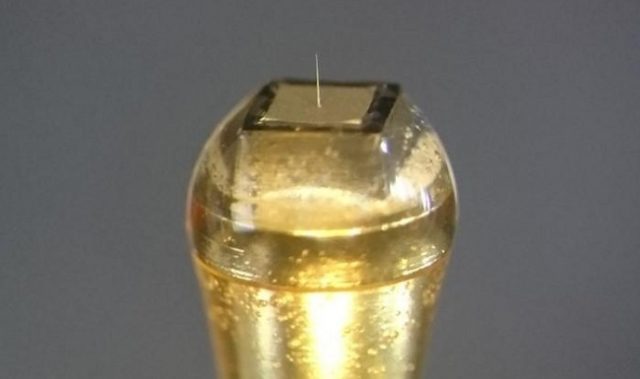
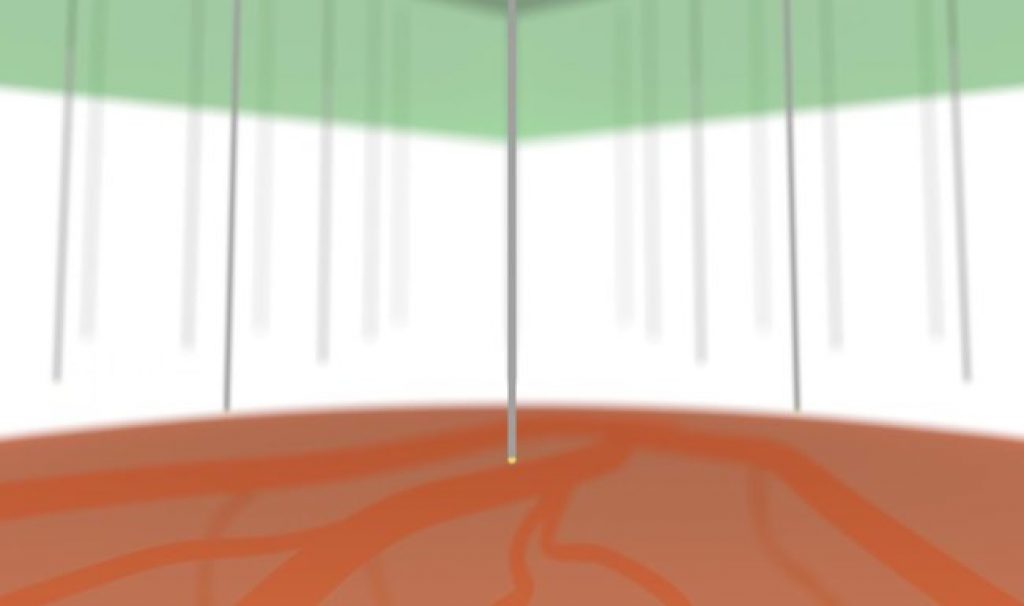
Now, a research team in the Department of Electrical and Electronic Information Engineering and the Electronics-Inspired Interdisciplinary Research Institute (EIIRIS) at Toyohashi University of Technology has developed a methodology to temporarily enhance the stiffness of a long, high-aspect-ratio flexible microneedle without affecting the needle diameter and flexibility in tissue.
This has been accomplished by embedding a needle base in a film scaffold, which dissolves upon contact with biological tissue. Silk fibroin was used as the dissolvable film because it has high biocompatibility and is a known biomaterial used in implantable devices.
“We quantitatively analyzed needle stiffness and evaluated the penetration capability by using mouse brains in vitro and in vivo,” explained study first author Mr. Satoshi Yagi, a master’s degree student at Toyohashi.
“In addition, as an actual needle application, we demonstrated fluorescence particle depth injection into the brain in vivo, and confirm that by observing confocal microscope,” said study co-author, PhD candidate Mr. Shota Yamagiwa.
According to project team leader Associate Professor Takeshi Kawano, their microneedle system has the potential to reduce the invasiveness of brain surgery and provides a safer tissue penetration method than conventional approaches.
“Preparation of the dissolvable base scaffold is very simple, but this methodology promises powerful tissue penetrations using numerous high-aspect-ratio flexible microneedles, including recording/stimulation electrodes, glass pipettes, and optogenetic fibers,” he said.
The article can be found at: Yagi et al. (2015) Dissolvable Base Scaffolds Allow Tissue Penetration of High-Aspect-Ratio Flexible Microneedles.
———
Source: Toyohashi University of Technology.
Disclaimer: This article does not necessarily reflect the views of AsianScientist or its staff.