AsianScientist (Mar. 11, 2015) – Using thin films rather than bulk samples, researchers have managed to greatly increase the superconducting critical temperature of iron chalcogenide. Their results, published in the Proceedings of the National Academy of Sciences, are a crucial step towards clarifying the mechanism of superconductivity.
When cooled below critical temperature, certain materials exhibit a property known as superconductivity, whereby they are able to conduct electricity with zero resistance. Despite their unique and useful properties, practical applications of superconductors have been limited due to the extremely low temperatures required.
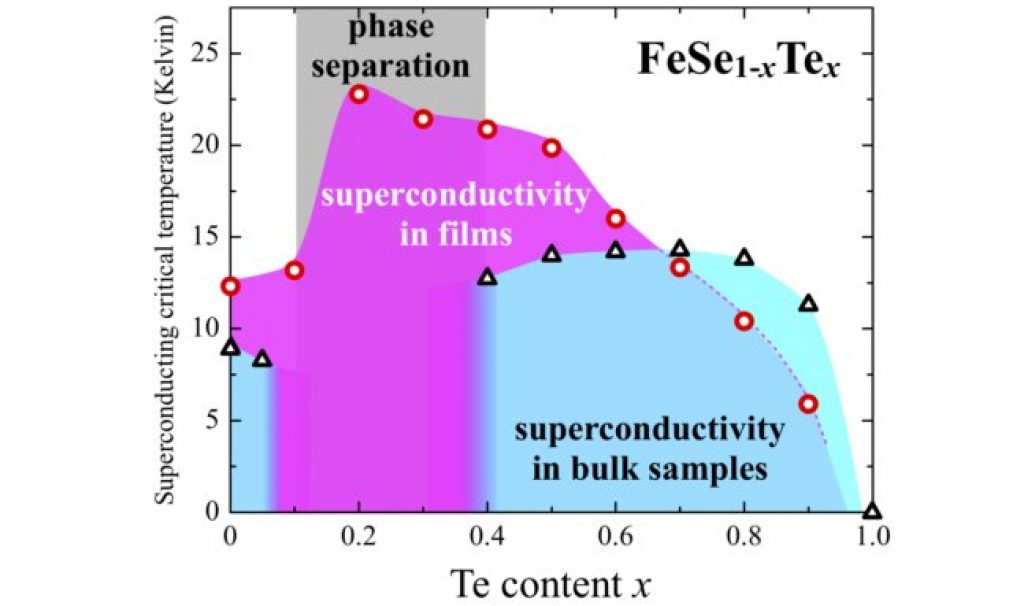
In the present study, a team of researchers led by Assistant Professor Yoshinori Imai and Professor Atsutaka Maeda from the Department of Basic Science at the University of Tokyo Graduate School of Arts and Sciences have demonstrated a giant enhancement in superconducting critical temperature in iron chalcogenide, increasing it from 15 Kelvin (-258 centigrade) to 23 Kelvin (-250 centigrade). These remarkable results were achieved by creating an iron chalcogenide film with a composition that was difficult to achieve with conventional manufacturing methods.
Iron chalcogenide is comprised of iron, tellurium and selenium. Using conventional synthetic procedures, regions exist in which a single solid solution does not form, that is, regions are formed in which the ratio of selenium and tellurium are not constant and phase separation occurs. This was a significant obstacle to understanding the characteristics of the iron chalcogenide. The current research has overcome this obstacle for the first time by creating an iron chalcogenide film.
Since iron chalcogenide is an iron-based superconductor, this research should be a crucial step in the clarification of the mechanism of superconductivity in these materials. In addition, the resulting giant enhancement of critical temperature observed in this study will accelerate research toward the application of iron-based superconductors and will also provide a novel route for increasing critical temperature in other superconductors.
The article can be found at: Imai et al. (2015) Suppression of Phase Separation and Giant Enhancement of Superconducting Transition Temperature in FeSe1−xTex Thin Films.
———
Source: University of Tokyo.
Disclaimer: This article does not necessarily reflect the views of AsianScientist or its staff.