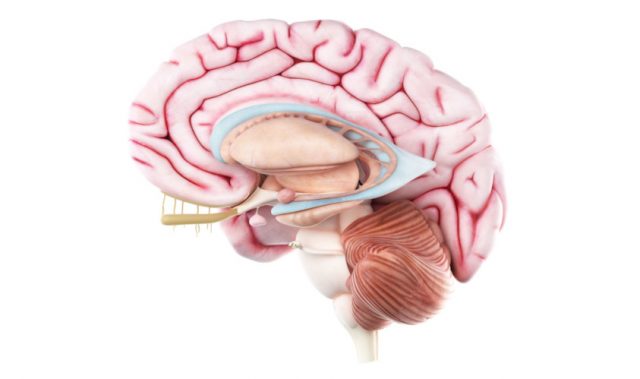
AsianScientist (Feb. 3, 2015) – Using a technique first developed in mice, researchers have pinpointed the region of the brain required for song generation in zebra finches. Their results have been published in the European Journal of Neuroscience.
Zebra finches are a model of vocalization with well-understood behavior, song patterns and brain anatomy. As it is with human speech, vocalization can be identified as a series of motor patterns, or a coordinated set of movements involving both reflex and voluntary actions. The creation of specific acoustic patterns requires well-coordinated neuronal circuitry.
However, identifying which group of neurons is responsible for a specific action or response is complex as brain scans such as functional magnetic resonance imaging, fMRI, can give only so much detail.
“Even though we know which general areas are functioning during certain tasks or behaviors, we have no idea how many of the neurons in that area are actually working. In some cases even a five percent change in neuron activity can have an effect,” explained first author of the present study, Professor Yoko Yazaki-Sugiyama from the Okinawa Institute of Science and Technology Graduate University (OIST).
New methods for examining the brains function in more detail—such as chemogenetic inhibition—have been refined and gaining popularity in the scientific community over the past ten years. Chemogenetic inhibition had been previously applied to mice and has been shown to be just as effective in zebra finches. It uses genetic manipulation to make neurons sensitive to selected chemicals or drugs. Once the neurons are modified, a predetermined drug can then be administered to temporarily deactivate these newly sensitive neurons.
Previously, one of the only other methods of blocking neuronal activity was by creating micro-lesions in parts of the brain where almost all of neurons there are permanently damaged or killed. Instead, chemogenetic inhibition is at the neuronal level and is only a temporary process, affecting a subset of neurons. The finch’s ability to sing recovers within hours after the effect of the drug has worn off.
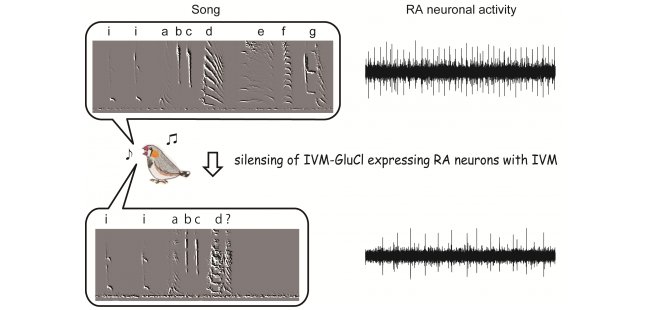
Together with colleague Dr. Shin Yanagihara and collaborators from the International Institute for Integrative Sleep Medicine at Tsukuba University and the Division of Sleep Medicine at Harvard University, Yazaki-Sugiyama found that silencing the neurons in a region of the brain known as the arcopallium made zebra finch songs erratic and incomplete. In previous studies using micro lesions on this area of the brain, birds lost the ability to sing almost all components of a song.
In contrast, the chemogenetic inhibition method revealed however that the song was only diminished at specific parts, with only some syllables being affected or absent. The syllables affected differed from bird to bird, however the order of syllables did not change. This suggests that the arcopallium controls of the composition of acoustic structure of songs and not their order or timing. It also demonstrated how precise this neuronal suppression method can be in determining the function of very small groups of neurons.
The results themselves are not only interesting, but proof that the marriage between this highly refined technique and a well understood model animal in science has more to offer for future studies.
“The technique itself is a causal one. So if you want to know the detail of how a general area in the brain functions, you could use this to silence the activity there and then see the behavioral change caused by the silencing. On top of that, one of the best merits of this is that its reversible as well, meaning we can be more thorough with follow ups in future research,” she added.
The article can be found at: Yazaki-Sugiyama et al. (2014) Acute Inhibition of a Cortical Motor Area Impairs Vocal Control in Singing Zebra Finches.
—–
Source: OIST; Photo: Patrick_K59/Flickr/CC.
Disclaimer: This article does not necessarily reflect the views of AsianScientist or its staff.