Asian Scientist (Oct. 3, 2013) – Scientists in China have developed a new, environmentally-friendly electronic alloy consisting of 50 aluminum atoms bound to 50 atoms of antimony.
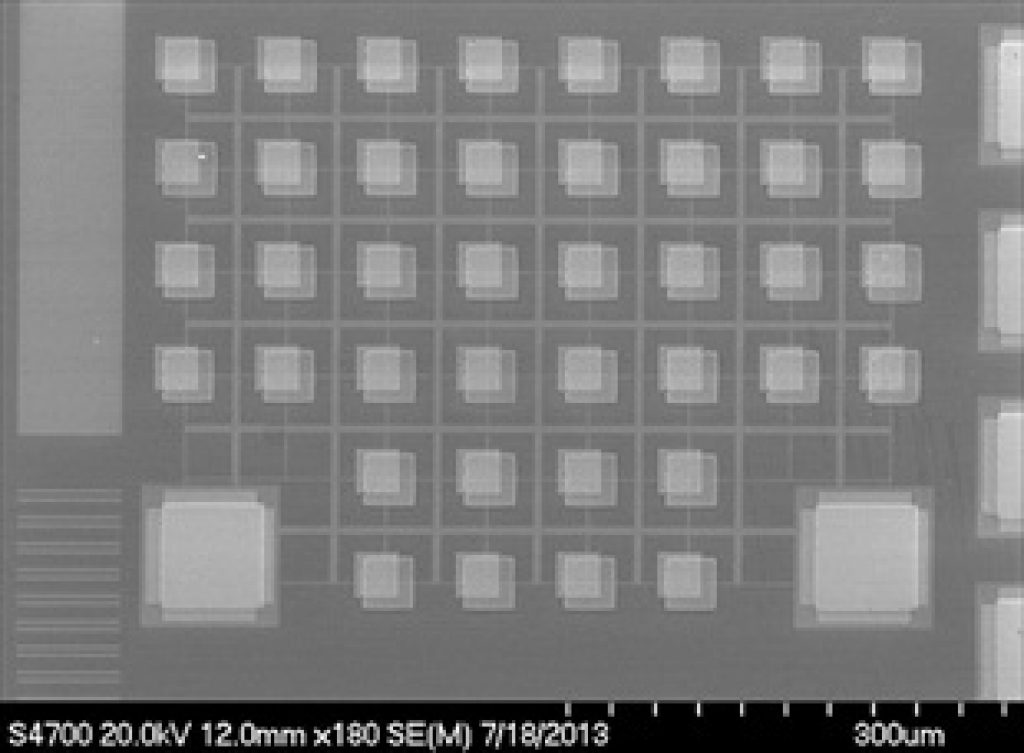
The new alloy, described in a paper in Applied Physics Letters, can potentially be used to build next-generation “phase-change” memory devices for data-storage applications in the future.
Phase-change memory is actively pursued as an alternative to the ubiquitous flash memory technology for data storage applications. This is because flash memory is limited in its storage density and phase-change memory can operate much faster.
Phase-change memory relies on materials that change from a disordered, amorphous structure to a crystalline structure when an electrical pulse is applied. Such a material will have high electrical resistance in its amorphous state and low resistance in its crystalline state – corresponding to the 1 and 0 states of binary data.
So far, the most popular material for phase-change memory devices contains germanium, antimony, and tellurium. However, compounds with three elements are difficult to work with.
“It’s difficult to control the phase-change memory manufacturing process of ternary alloys such as the traditionally used germanium-antimony-tellurium material,” said Xilin Zhou, the lead author of the study. “Etching and polishing of the material with chalcogens can change the material’s composition, due to the motion of the tellurium atoms.”
Therefore, the researchers turned to a material with just two elements: aluminum and antimony. They studied the material’s phase-changing properties, and found that it is more thermally stable than the germanium-antimony-tellurium compound.
The researchers also discovered that an alloy consisting of exactly 50 aluminum atoms bound to 50 atoms of antimony has three distinct levels of resistance. This means that the material has the ability to store three bits of data in a single memory cell, instead of just two. It may therefore be useful for multilevel data storage.
“A two-step resistance drop during the crystallization of the material can be used for multilevel data storage (MLS) and, interestingly, three distinct resistance levels are achieved in the phase-change memory cells,” Zhou says. “So the aluminum-antimony material looks promising for use in high-density nonvolatile memory applications because of its good thermal stability and MLS capacity.”
The researchers are now investigating the endurance or reversible electrical switching of the phase-change memory cell with MLS capacity.
The article can be found at: Zhou et al. (2013) Phase Transition Characteristics Of Al-Sb Phase Change Materials For Phase Change Memory Application.
——
Source: AIP.
Disclaimer: This article does not necessarily reflect the views of AsianScientist or its staff.