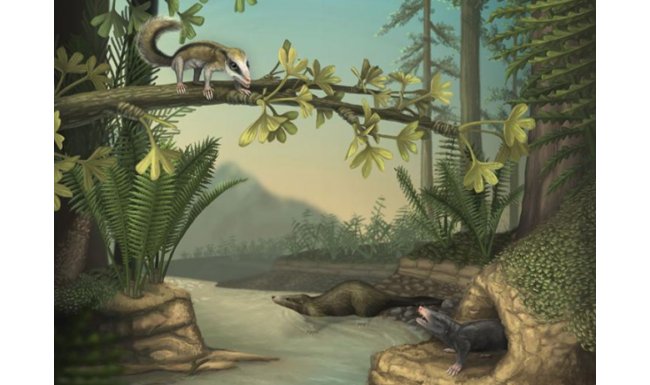
Asian Scientist (Aug. 16, 2013) – A 160 million-year-old fossil of an extinct rodent-like creature from China is helping to explain how multituberculates — the most evolutionarily successful and long-lived mammalian lineage in the fossil record — achieved their dominance.
The fossil find, reported in Science, represents a newly discovered species known as Rugosodon eurasiaticus.
The nearly complete skeleton of the oldest ancestor of multituberculates found to date provides critical insights into the traits that helped these mammals thrive in their day.
For example, the fossil reveals teeth that were adapted to gnawing plants and animals alike, as well as ankle joints that were highly adept at rotation.
In light of these findings, researchers suggest that R. eurasiaticus paved the way for later plant-eating and tree-dwelling mammals.
The multituberculates flourished during the Cretaceous era, which ended over 60 million years ago.
Much like today’s rodents, they filled an extremely wide variety of niches below the ground, on the ground and in the trees.
According to the researchers, this new fossil, which resembles a small rat or a chipmunk, possessed many of the adaptations that subsequent species came to rely upon.
“The later multituberculates of the Cretaceous [era] and the Paleocene [epoch] are extremely functionally diverse: Some could jump, some could burrow, others could climb trees and many more lived on the ground,” said Zhe-Xi Luo, a co-author of the study.
Additionally, R. eurasiaticus could eat many different types of food. The fossil possessed teeth designed for shearing plant matter, confirming a 2012 analysis of tooth types that suggested multituberculates consumed an animal-dominated diet for much of their existence, later diversifying to a plant-dominated one.
Multituberculates arose in the Jurassic period and went extinct in the Oligocene epoch, occupying a diverse range of habitats for more than 100 million years before they were out-competed by more modern rodents.
By the end of their run on the planet, multituberculates had evolved complex teeth that allowed them to enjoy vegetarian diets and unique locomotive skills that enabled them to traverse treetops.
Both adaptations helped them to become dominant among their contemporaries.
The article can be found at: Yuan et al. (2013) Earliest Evolution Of Multituberculate Mammals Revealed By A New Jurassic Fossil.
——
Source: AAAS; Photo: ronancrowley/Flickr/CC.
Disclaimer: This article does not necessarily reflect the views of AsianScientist or its staff.