AsianScientist (Sep. 3, 2012) – Researchers from the United States and China have found evidence that a feathered but flightless dinosaur was able to snag and consume small flying dinosaurs.
The finding were published in PLoS ONE after scientists from the University of Alberta and the Pipestone Creek Dinosaur Initiative, both based in Canada, and the Chinese Academy of Geological Sciences conducted joint research on fossils unearthed in Yixian county in Liaoning province.
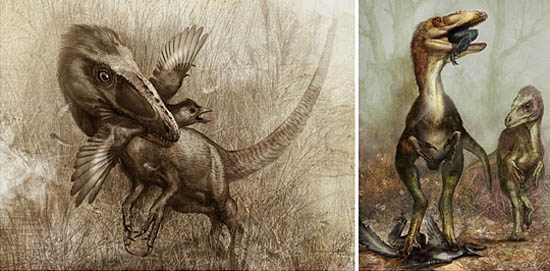
The paleontologists found the fossilized remains of three flying dinosaurs in the belly of Sinocalliopteryx, a raptor-like predator that was about two meters long and roughly the size of a modern-day wolf.
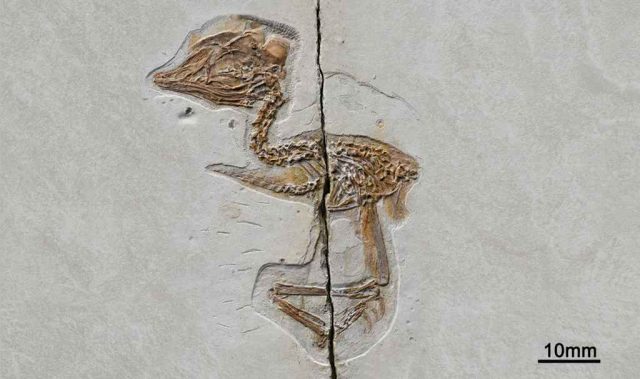
Sinocalliopteryx’s flying meals were three Confuciusornis, one of the earliest known birds, which had a crude version of a modern bird’s skeleton and muscles. The researchers say such primitive birds were probably limited to slow takeoffs and short flights.
According to the researchers, this is the first time a predator has been linked to the killing of multiple flying dinosaurs.
Theories for how the dinosaurs were able to catch flying birds are aplenty; One hypothesis suggests that the birds were scavengers, another suggests that the birds were adept at jumping into the air and catching their prey.
“They might have stealthily approached alighting birds and launched a blitz,” lead author Xing Lida told Xinhua News.
Scott Persons, a U of A paleontology student and research co-author, explained that Sinocalliopteryx had feathers or hair-like fuzz covering its body, creating a level of insulation that helped maintain a warm body temperature and a high metabolism that required a lot of food to fuel.
“The fact that this Sinocalliopteryx had not one, but three undigested birds in its stomach indicates it was a voracious eater and a very active hunter,” said Persons.
The researchers also analyzed stomach contents of a second Sinocalliopteryx fossil discovery from that area. The researchers identified this Sinocalliopteryx’s last meal as a Sinornithosaurus, a small feathered meat-eater about the size of a house cat that may have been able to fly or glide short distances.
“Sinornithosaurus is a relative of Velociraptor, which means this is the first direct evidence of a raptor becoming another predatory dinosaur’s meal,” said Persons.
The article can be found at: Xing et al. (2012) Abdominal Contents from Two Large Early Cretaceous Compsognathids (Dinosauria: Theropoda) Demonstrate Feeding on Confuciusornithids and Dromaeosaurids.
——
Source: University of Alberta; Photo: Cheung Chungtat/U. Alberta.
Disclaimer: This article does not necessarily reflect the views of AsianScientist or its staff.