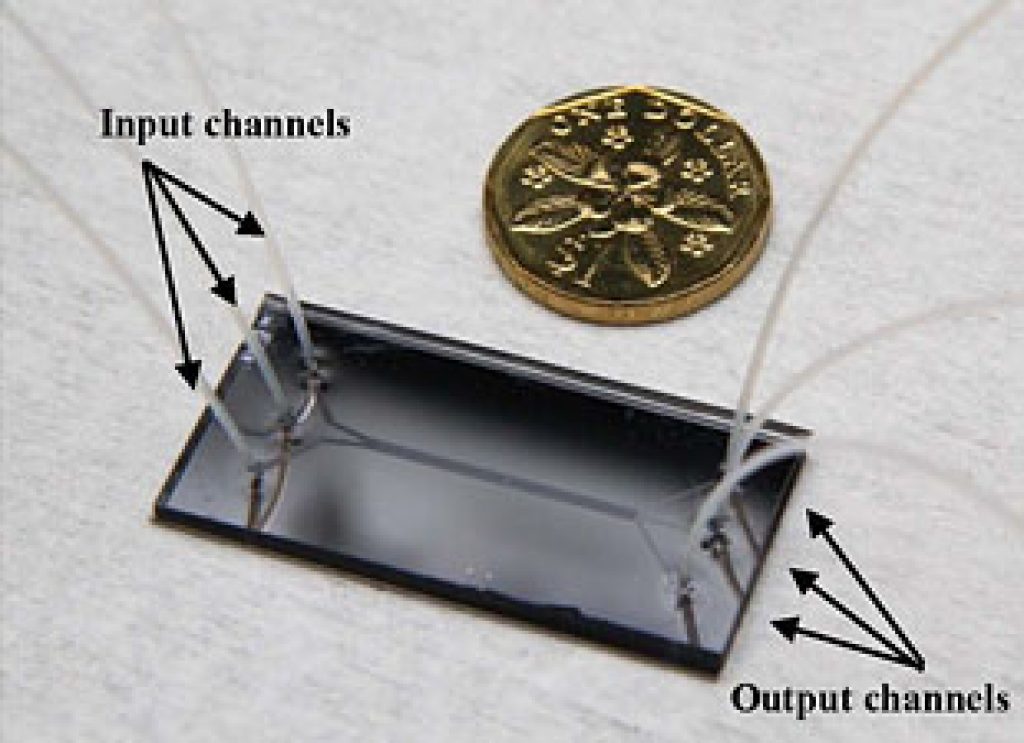
AsianScientist (Apr. 22, 2013) – Researchers in Singapore have developed a novel microfluidic device that can be used to efficiently and rapidly separate and detect non-spherical bioparticles.
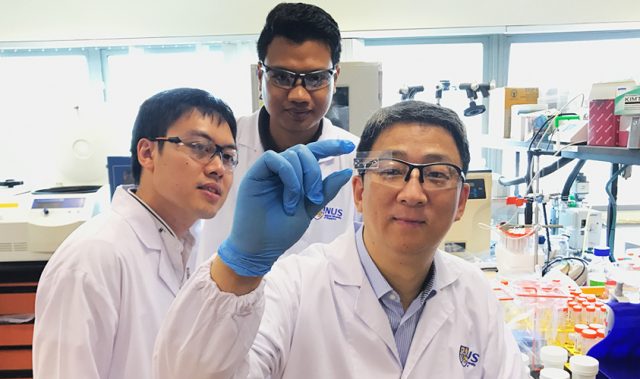
Microfluidic devices deal with the behavior, precise control, and manipulation of fluids that are geometrically constrained to the sub-millimeter scale. This new device, which separates and detects non-spherical bioparticles such as pathogenic bacteria and malaria infected red blood cells, was developed by a bioengineering research team from the National University of Singapore (NUS) team led by Associate Professor Zhang Yong.
The team’s findings, published recently in Nature Communications, show that their “I-shaped” pillar array device could be used to separate rod-shaped Escherichia coli bacteria in less than an hour compared to 24-48 hours required for bacterial detection by using conventional methods.
The I-shape pillar array induces rotational movements of the non-spherical particles which in turn increases the effective hydrodynamic size of the bioparticles flowing in the device, allowing for efficient separation.
“Many of the pathogenic bacteria are non-spherical but most of microfluidic devices today are for separating spherical cells. Our method uses a special I-shape pillar array which is capable of separating non-spherical or irregularly-shaped bioparticles,” said Zhang. “With our current findings, we hope to move on to separate other non-spherical bioparticles like fungi, with higher throughput and efficiency, circumventing the spherical size dependency of current techniques.”
The article can be found at: Zeming KK et al. (2013) Rotational separation of non-spherical bioparticles using I-shaped pillar arrays in a microfluidic device.
——
Source: NUS.
Disclaimer: This article does not necessarily reflect the views of AsianScientist or its staff.