

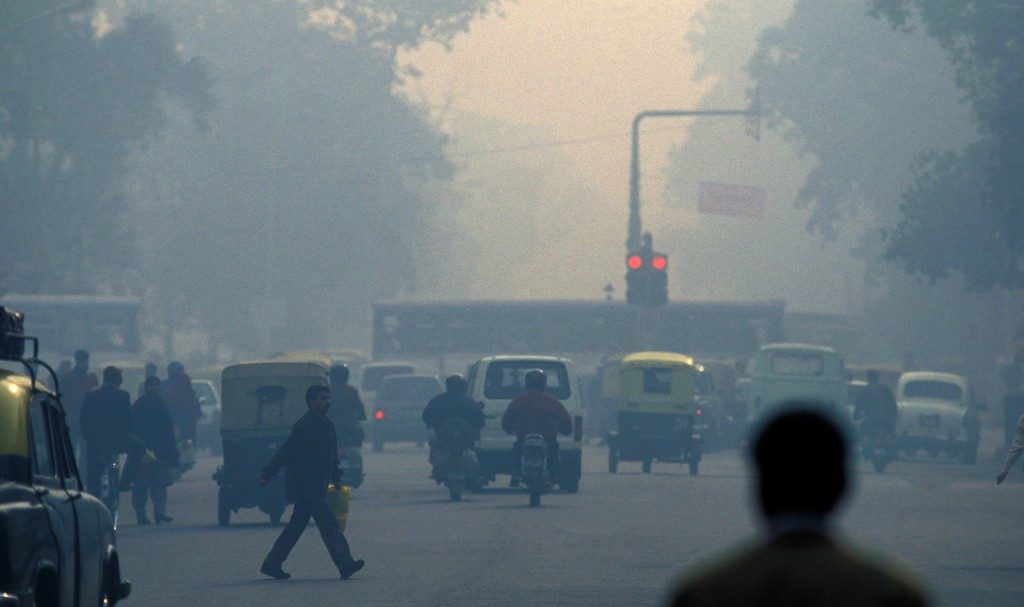
AsianScientist (Oct. 19, 2026) –Of the 50 most polluted cities in the world in 2025, 29 are in India. It is well-known that poor air quality traps heat and contributes to the rising temperature in the region. Now, researchers from Hong Kong Baptist University have found that the country’s extreme heat might also be making its air even more polluted, creating a dangerous feedback loop.
Their study, published in Advances in Atmospheric Sciences, also details how an anomalous weather pattern fuels the feedback loop in India’s northern region.
Combined with rising temperatures, this helps explain why northern India has been experiencing more days of concurrent heat waves and severe air pollution, known as co-extreme days.
“Most studies have focused on heat waves and air pollution separately,” said lead author Huibin Dai of Hong Kong Baptist University. “This study shows that large-scale atmospheric circulation can simultaneously intensify heat and promote secondary aerosol formation.”
Before 2020, the number of co-extreme days in India was actually declining. After 2020, however, the trend reversed.
Delhi, a densely populated city in northern India, experienced extreme heat and severe air pollution on more than half of the days in April 2022. From 2017 to 2024, the city recorded a total of 388 co-extreme days.
The researchers investigated whether the increase in human emissions after the pandemic could explain why co-extreme days have become more frequent. To find out, the team analyzed satellite observations and air quality monitoring data from 2017 to 2024, then simulated a scenario in which human emissions remained at 2017 levels while chemical and meteorological processes changed from year to year.
The simulations reproduced much of the observed changes in air pollution and temperature, which suggests that meteorological and chemical factors might be playing significant roles.
During extreme heat, concentrations of tiny organic carbon particles in the atmosphere rose to as much as 2.3 times their average levels. These concentrations were even higher on co-extreme days than on days when air pollution was high but temperatures were normal.
Unlike smoke and dust particles which are emitted directly into the air, organic carbon forms through chemical reactions in the atmosphere. Heat accelerates these reactions, producing more particles that contribute to air pollution.
This effect is compounded by anticyclonic circulation, a weather pattern that occurs particularly in northern India. It causes air to sink and spread outward near the ground, restricting vertical airflow. As a result, heat and pollutants accumulate near the surface rather than dispersing into the upper atmosphere.
The findings highlight how atmospheric chemistry and weather patterns can interact to shape air quality during extreme heat events, with potential consequences for public health.
“The next step is to investigate how compound extremes will evolve under future climate change and to quantify their impacts on human health,” Dai said. “Ultimately, this work aims to provide scientific evidence to support early prevention, risk reduction, and climate adaptation.”
—
Source: Institute of Atmospheric Physics, Chinese Academy of Sciences ; Image: amnat30/shutterstock
The study can be found at: Revival of Compound Heat–PM2.5 Extremes in Pre-Monsoon India: Meteorological Shifts and Fueled Secondary Aerosol Production (2017–24)
Disclaimer: This article does not necessarily reflect the views of AsianScientist or its staff.