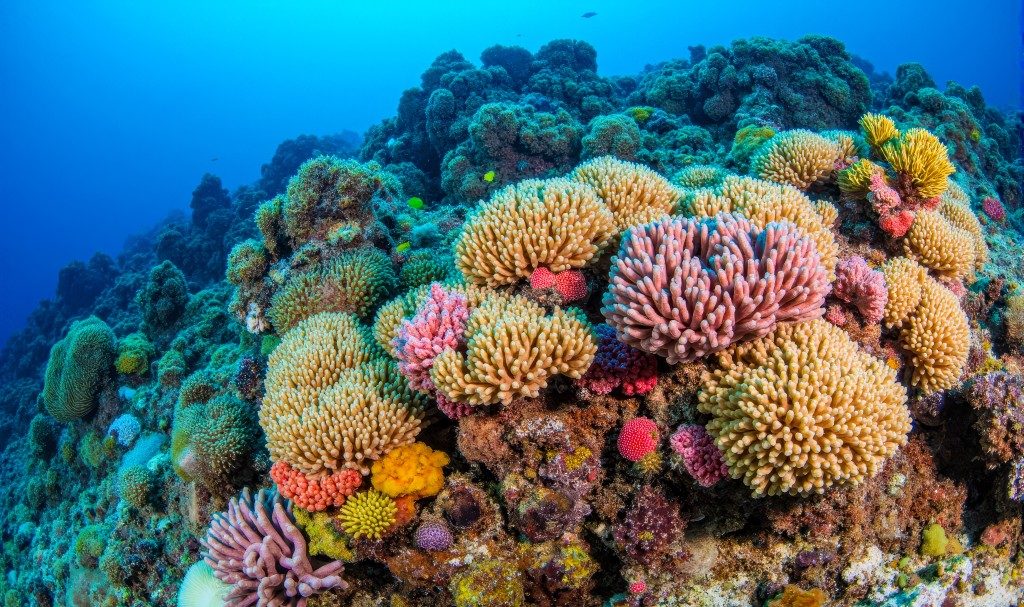
AsianScientist (Sept. 30, 2026) –Coral reefs are well known as beautiful, diverse, ocean ecosystems. It might then come as a surprise to learn that they can drown.
Corals and other reef organisms build up reefs by producing calcium carbonate, the hard material that forms reef structures, so that they can stay close to the surface and receive sunlight.
When sea level rise outpaces the corals’ ability to build, the reef drowns, sitting under deepening water.
Researchers from Nanyang Technological University (NTU), Singapore recently found that 76% of reef sites they studied will be unable to keep up with projected sea-level rise in a high greenhouse gas emissions scenario.
“Coral reefs have kept pace with rising seas for thousands of years, but the rate of sea-level rise expected in the coming decades could exceed the limits of most reefs,” said Assistant Professor Morgan, Associate Chair at the Asian School of the Environment, Nanyang Technological University (NTU), Singapore.
To predict how coral might react to current rising sea levels, the scientists analysed ancient reef records in the form of coral cores, analysing 288 records from 93 sites in the Indo-Pacific region over the past 11 700 years.
Coral cores reveal the layers of skeletal carbonate built up over time, showing coral reef growth patterns during historical changes in sea level. This allows scientists to study the whole reef framework, not just individual coral colonies.
“An individual coral can grow relatively quickly, but that does not mean an entire reef will build upwards at the same rate. Reef cores can show us how much structure was preserved after accounting for growth, erosion and other natural processes, which then provides a more realistic measure of whether reefs can keep pace with future sea-level rise” said Dr Riovie Ramos, Research Fellow at NTU’s Earth Observatory of Singapore.
Based on the study, if sea level rise exceeds 5.3mm a year, it is highly unlikely that reefs will be able to maintain their growth, a scenario which could happen within 35 years
“When that happens, reefs will become progressively submerged. They may still contain living corals, but they will no longer function in the same way, potentially allowing greater wave energy to reach the coastline and increasing risks to coastal communities,” said Assistant Professor Morgan
Coral reefs absorb the force of waves before they hit the coast. As the water level above them rises, larger waves can pass over, threatening low-lying coastal areas and islands with erosion and flooding.
Reef drowning also threatens the marine life that rely on coral reefs for food and shelter, affecting communities that depend on fishing and tourism for their livelihoods.
The researchers note that coral type matters to reef building – the competitive coral species that dominated ancient reefs produce complex reef structures quickly. Now, it is increasingly common to find stress-tolerant ‘weedy’ coral species that are capable of colonising disturbed areas, but cannot build structures as rapidly.
Controlling local factors such as pollution and overfishing can help to maintain healthy coral reefs that continue growing.
However, these measures cannot make up for sea levels rising too rapidly for corals to keep up. A significant reduction in greenhouse gas emissions alongside local coral protection strategies will be needed to keep coral reefs safe.
—
Source: Nanyang Technological University, Singapore; Image: Muravev/Magnific
This article can be found at: Paleorecords inform the limits of Indo-Pacific coral reef survival under accelerating sea-level rise
Disclaimer: This article does not necessarily reflect the views of AsianScientist or its staff.