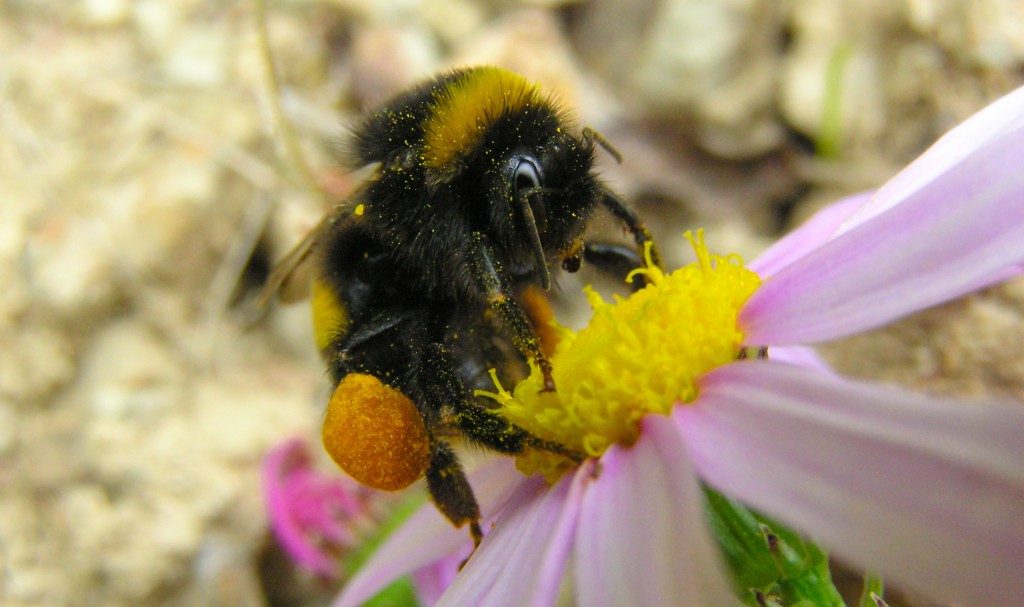
AsianScientist (Aug. 07, 2026) – For a long time, insects were treated as mini-robots: animals that turn a fixed input into a fixed output. For example, an ant following a pheromone trail, or a bee building comb within the colony. But insects are more than that — they can exhibit higher cognition, including abstract concepts.
A new study published in PNAS, from authors based in China and Australia, adds to this growing case: bumblebees show “facial expressions” when they taste something, whether appetitive (sweet) or aversive (salty or bitter). Bumblebees keep flicking their tongue out in a lapping motion even after they’ve swallowed a sugar solution, whereas they shake their heads vigorously and wipe their mouths at salty and bitter solutions, without swallowing them. This tracks whether they like what they’ve eaten, not just whether they’ll eat it — the same kind of reaction shows up in mammals.
However, do these “yum” or “eww” face expressions reflect liking or wanting in bees? To test this, the researchers devalued the reward while keeping the bees willing to eat — mixing sugar with salt, or testing bees when they were nearly full, or offering weak sugar right after a rich batch. The bees almost always drank, but rarely made the “yum” or “eww” face: somewhat closer to “thanks I’m full but not so delighted”. So the post-feeding facial expressions track a like, not a want.
“Like” and “want” are often distinct in the brain’s chemistry. Dopamine, and, in insects, sometimes octopamine, drives the motivation to seek and eat food, the “want.” Pleasure runs on a different system: endocannabinoids, reward-related molecules better known in mammals. Anandamide, one such molecule, was long assumed absent in insects, but a recent study found honeybees make it themselves from their diet, which made it the ideal test. When the researchers dabbed these compounds onto the bee’s thorax, the split was clean: dopamine and octopamine made bees keener to feed but did nothing to the “yum” face, while anandamide boosted it. Different chemistry for wanting and for liking, just as in mammals.
All of this gives researchers something they’ve rarely had: a quick, visible way to read whether an insect likes something, in a brain that weighs less than a milligram. It doesn’t prove bees feel pleasure the way we do — and the authors are careful not to say so — but it does hand the question of an insect “inner life” something you can actually test at the bench, opening up newer avenues into insect emotion and sentience.
—
Source: Southern Medical University, Guangzhou ; Image: Tony Wills/Wikimedia Commons
The study can be found at: Yonghe Zhou et al. 2026. Bumblebees’ orofacial reactions to tastes provide evidence for affective evaluation
Disclaimer: This article does not necessarily reflect the views of AsianScientist or its staff.