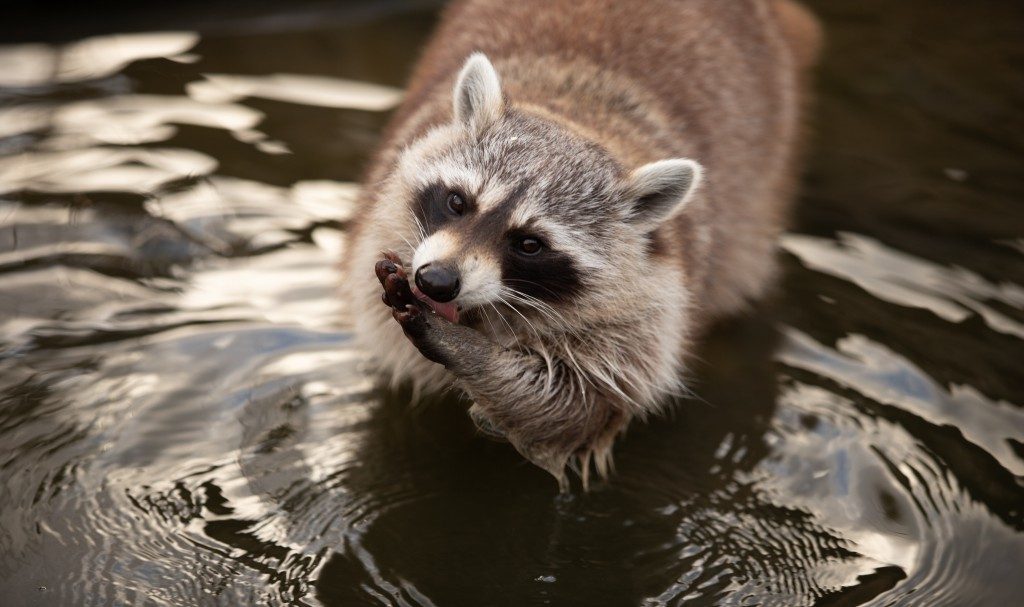
AsianScientist (Jul. 12, 2026) – Raccoons first arrived in Japan during the 1970s after a popular children’s anime featuring a pet raccoon gained widespread acclaim. In response to the show’s popularity, people began importing raccoons as pets.
However, these omnivores are not native to Japan and are listed among the 156 invasive alien species by the country’s environment ministry. Their population grew rapidly as many pets were either abandoned or escaped, allowing them to thrive in the wild. Local authorities struggled to control the growing population because raccoons breed quickly and adapt easily to new environments.
A recent study by Osaka Metropolitan University (OMU) has gathered evidence suggesting invasive raccoons may contribute to the environmental spread of Escherichia albertii, which has caused outbreaks of severe food poisoning.
The findings were published in the journal Applied and Environmental Microbiology.
People can become infected with the bacterium by consuming contaminated water or foods such as raw vegetables that come into contact with contaminated water. Because raccoons are closely associated with water sources, contaminated rivers have long been suspected as a source of infection.
To investigate, researchers collected 64 water samples from eight river systems in Osaka Prefecture, where raccoon populations are particularly high between 2022 and 2023, focusing on the upper and middle reaches where wildlife habitats overlap with rivers.
Using a species-specific genetic test, they detected E. albertii in 49 of the 64 samples (76.6%) and in six of the eight river systems (75%), showing that the bacterium is widespread in these waterways.
In one river system, the bacterium was found at 15 of 18 sampling sites (83.3%), including water collected close to the river’s source. It was also detected in the upper reaches of several other rivers.
To determine whether the bacterium persisted over time, the researchers repeatedly collected water samples from the same locations over several months, including samples taken 30 minutes apart.
Almost every sample tested positive, suggesting Escherichia albertii is consistently present in these rivers rather than appearing only occasionally.
The few water samples that tested negative were mostly collected during winter and early spring, when previous studies have shown raccoons are less likely to carry the bacterium.
Further genetic analysis revealed multiple bacterial strains, with 79 different strains identified from river water, indicating the pathogen is well established in the ecosystem rather than originating from a single outbreak. Even in samples where the bacterium could not be grown in the laboratory, additional genetic tests confirmed its presence.
Supporting the river findings, analysis of 122 wild raccoons showed that 56% carried Escherichia albertii. The researchers also compared the DNA of bacteria isolated from river water, raccoons, and infected people using whole-genome sequencing.
Usually, riverborne bacteria accumulate downstream, but the researchers also found the bacterium upstream and near river sources, including areas far from residential districts, farms, and recreational facilities, strongly suggesting that wildlife, rather than human activity, was introducing it into the rivers.
“Overall, these findings suggest that E. albertii is widely distributed in environmental waters,” said Atsushi Hinenoya, Associate Professor, Graduate School of Veterinary Science at OMU.
“Much of this contamination was strongly associated with wild animals,” he added.
Whole-genome analysis revealed that many strains from raccoons and river water were closely related, including one raccoon strain and one river-water strain collected in the same city at around the same time.
The analysis also showed that every sequenced strain carried genes linked to human disease, and some were closely related to strains previously isolated from infected patients, including strains associated with a major foodborne outbreak in Japan in 2017.
“The key takeaway is that all isolates possessed virulence genes associated with human pathogenicity, and some were closely related to strains derived from human patients,” explained Hinenoya.
However, according to the researchers, this is not conclusive proof that raccoons are the main source because other wild animals, including birds, may also spread the bacterium.
The researchers stressed that monitoring only human infections is no longer enough and instead advocate a One Health approach that considers human, animal, and environmental health together to better understand and reduce the risk of future outbreaks.
“The approach used in this study can be applied to other zoonotic diseases,” said Hinenoya.
“We hope to expand this research toward the development of comprehensive strategies for infectious disease control,” he added.
The team now plans to investigate the precise contamination routes linking raccoons, environmental water, agricultural products, and food.
—
Source: Osaka Metropolitan University; Image: magnific/wirestock
This article can be found at Integrated study on the occurrence and genomic features of Escherichia albertii in environmental water and raccoons in Japan
Disclaimer: This article does not necessarily reflect the views of AsianScientist or its staff.