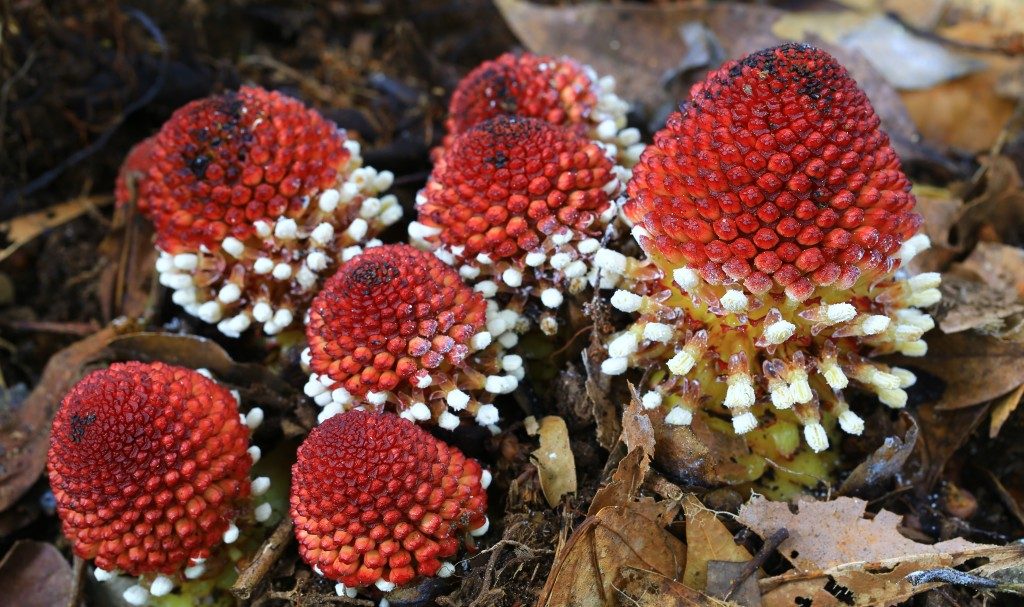
AsianScientist (Feb. 04, 2026) – At first glance, you might mistake the elusive Balanophora for mushrooms. In fact, they are parasitic plants that live underground, emerging only to flower.
Without the ability to photosynthesise, nor a root system of their own, they feed off the roots of host trees. Some species exclusively produce seeds asexually, a rare occurrence in the plant kingdom.
“Balanophora has lost much of what defines it as a plant, but retained enough to function as a parasite. It’s a fascinating example of how something so strange can evolve from an ancestor that looked like a normal plant with leaves and a normal root system,” said Dr Petra Svetlikova, Science and Technology Associate at the Okinawa Institute of Science and Technology(OIST).
Scientists from OIST, Kobe University and the University of Taipei collaborated to study plants from the Balanophora genus, a challenging endeavour as the picky plants parasitise only a few tree species.
“These plants are rare, patchy and often restricted to steep, humid forests. But years of experience with studying Balanophora both in the lab and in field studies, as well as long-standing relationships with local naturalists made this project possible,” said Suetsugu Kenji, botanist at Kobe University.
Sampling seven species of Balanophora from 12 populations across Taiwan and Japan, they conducted genetic analysis to map out the relationships between each species and find out how they adapted to their parasitic lifestyle.
The researchers were particularly interested in plastids – plant cell organelles that have their own genetic material, such as chloroplasts. As parasitic plants become more reliant on their hosts and abandon photosynthesis, their plastids tend to lose genes or even disappear entirely.
Balanophora is no different – its plastid genome is 10 times smaller than that of typical photosynthetic plants. “It is exciting to see how far a plant can reduce its plastid genome, which at first glance looks as though the plastid is on the verge of disappearing,” said Suetsugu. “But looking more closely we found that many proteins are still transported to the plastid, showing that even though the plant has abandoned photosynthesis, the plastid is still a vital part of the plant’s metabolism.”
The scientists also tracked the evolution of Balanophora’s atypical reproductive strategy. Some Balanophora species are capable of facultative agamospermy – producing seeds without fertilisation, and some are obligately agamospermous, exclusively reproducing in this manner.
Obligate agamospermy is exceedingly rare in plants, with disadvantages such as a lack of genetic diversity, accumulation of bad mutations, and a higher extinction risk.
“Fascinatingly, we found that the obligately agamospermous Balanophora species were all island species,” said Dr. Svetlikova. The ability to reproduce asexually allows a single female plant to propagate across a new landmass by cloning itself, an advantage when it comes to colonising islands.
The findings from this study are a useful stepping stone to understand non-photosynthetic plants and what role plastids play in sustaining them.
“Most known habitats of Balanophora are protected in Okinawa, but the populations face extinction by logging and unauthorised collection,” said Dr Svetlikova. “We hope to learn as much as we can about this fantastic, ancient plant before it’s too late. It serves as a reminder of how evolution continues to surprise us.”
—
Source: Kobe University, Okinawa Institute of Science and Technology ;Image: Jamikorn Sooktaramorn/Shutterstock
This article can be found at: Phylogenomics clarifies Balanophora evolution, metabolic retention in reduced plastids, and the origins of obligate agamospermy
Disclaimer: This article does not necessarily reflect the views of AsianScientist or its staff.