
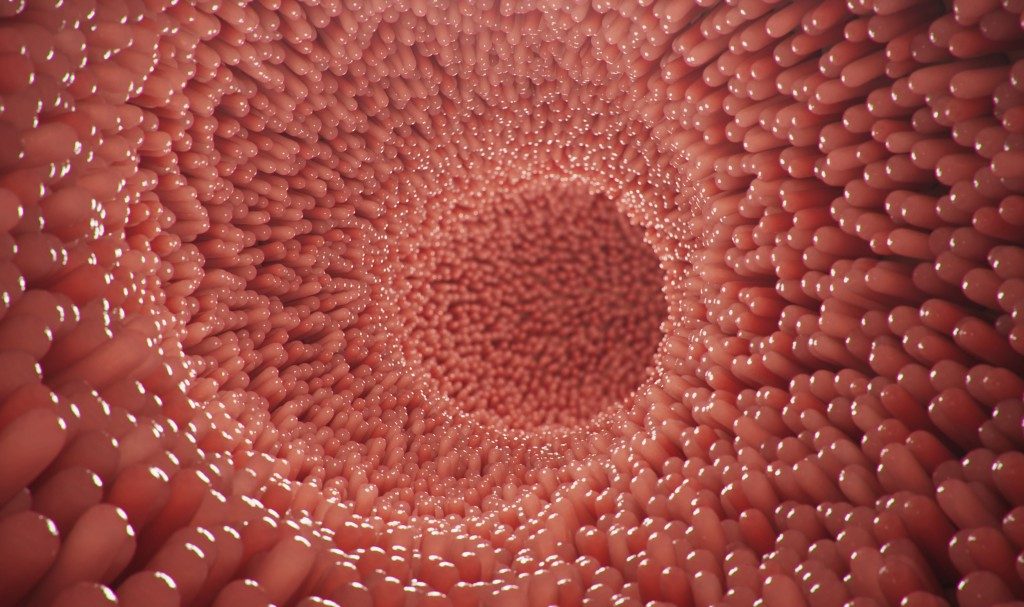
AsianScientist (Nov. 23, 2026) – What happens when you eat? As soon as you swallow the food, it lands inside you. The first cells to deal with it are the ones lining your gut.
Gut cells wear out fast and are constantly replaced. Cells usually die by neatly self-destructing, bursting open or digesting themselves. A few years ago, however, Sa Kan Yoo’s team at RIKEN in Japan spotted fruit fly gut cells dying slowly, without any of these signs. They gradually lost their skeleton and organelles and went dark under the microscope. The team named the process “erebosis”, after the Greek erebos, meaning darkness.
But what triggers erebosis? In a new study, the team asked whether it depends on what flies eat, and how much. The researchers fed flies diets with different amounts of sugar and amino acids, the building blocks of proteins, but with equal calories. Then they counted erebotic cells in the flies’ guts under a microscope. Changing the sugar made no difference to the count. But cutting amino acids by 90% increased erebosis, and adding them back reduced it.
The obvious explanation was that gut cells detect amino acids through their usual built-in sensors. But when the team switched them off, the gut cells still responded to amino acid levels as before. So perhaps the type of amino acid mattered. Proteins are built from 20 kinds of amino acids, so the team tested all 20, one at a time, at the levels found in the food. None stood out. Yet at much higher doses, every one reduced erebosis, a puzzle that stalled the project for a year.
The breakthrough came from α-aminoisobutyrate, an amino acid look-alike that cells can’t use or break down. If gut cells were reading amino acids chemically, this fake should have done nothing. Instead, it reduced erebosis just like the real thing. The cells were responding not to which amino acids were there, but to how much. It was quantity, not quality, all along.
So how can a cell measure how much amino acid it holds, without telling one kind from another? The team turned from chemistry to physics. A cell full of amino acids gets crowded inside, and its cytoplasm, the jelly-like fluid inside, turns thick and flows less easily. The team found two unusual sugars, arabinose and deoxyribose, that starving flies couldn’t use for energy. Both thickened the gut cells’ cytoplasm and suppressed erebosis.
In other words, gut cells feel full when their insides are thick. The researchers have a name for it: viscosatiety. When food is plentiful, the cytoplasm stays thick and gut cells survive to keep absorbing nutrients. When food runs short, the cytoplasm turns thin and watery, and more cells go into erebosis.
Until now, cells were thought to sense nutrients through chemical signals triggered by specific molecules. This study suggests they can also read their food supply physically. The team is now checking whether erebosis also happens in mice and humans.
—
Source: RIKEN ; Image: rost9/magnific
The study can be found at: Cytoplasmic fluidity couples nutrient availability and enterocyte fate in vivo
Disclaimer: This article does not necessarily reflect the views of AsianScientist or its staff.