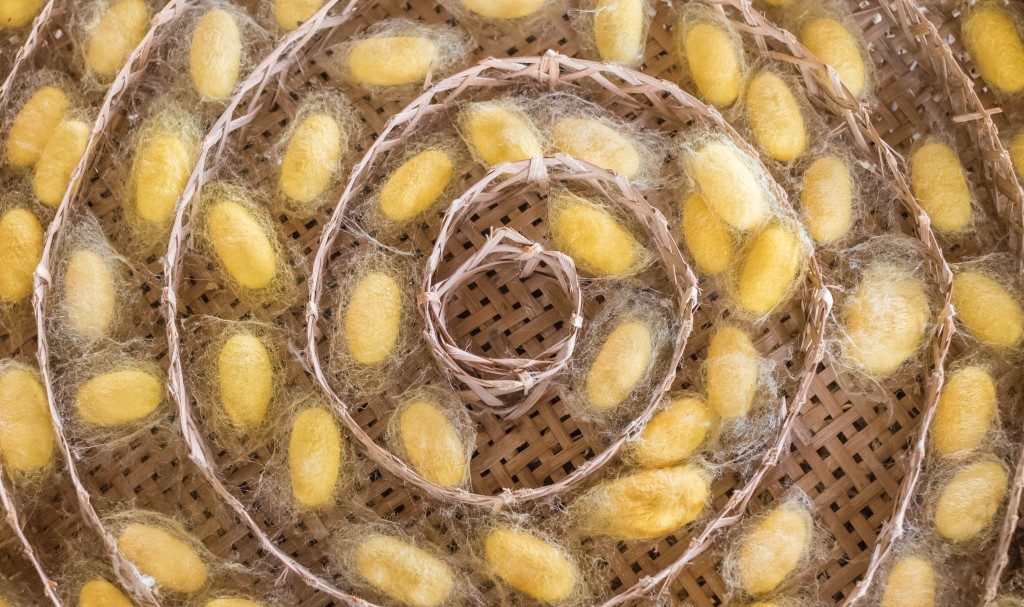
AsianScientist (Aug. 24, 2026) –After eating mulberry leaves for weeks, silkworms excrete thin threads of silk from their salivary glands to create cocoons. Farmers harvest these cocoons to create the silk fabrics we are all familiar with.
A new study published in the Journal of Industrial Textiles has found that adding a tiny amount of plant-based fiber to the silkworms’ diet creates silk yarns and fabrics that are stronger and less likely to shrink when washed.
Some techniques rely on toxic chemicals to strengthen the silk threads. Others employ extra steps in the silk production process to improve durability. The researchers turned to a simpler approach by feeding the silkworms microscopic fibers derived from plants, also known as cellulose nanofiber (CNF).
“Our goal was to improve silk while preserving its natural advantages,” said author Hiroki Kurita, associate professor at Tohoku University.
Silk produced this way can have a wide range of uses, the researchers say. While popular in fashion due to its lustrous sheen, silk is also used in many industries because of its smooth texture and biocompatibility.
“Silk is not just for fashion,” said Kurita. “Silk can be used in a medical setting as surgical sutures or a biomaterial to promote wound healing.”
The researchers work builds upon their previous research showing that silk fibers from CNF-fed silkworms have higher tensile strength, meaning that the fibers can withstand more force before breaking. The new study extends this by testing the tensile strength and shrinkage of a single silk filament, silk yarns (made of twisted silk filaments), and silk fabrics (made of woven silk yarns).
They found that the tensile strength of the single filaments improved by 50 percent. The twisted yarns and woven fabrics also showed improvements in tensile strength, although the gains were smaller.
When washed and dried, the team found no significant improvements in single filaments. However, normal yarns shrunk by about 0.4 percent after washing, whereas CNF-enriched yarns shrunk by only about 0.1 percent. Similarly, the woven fabrics shrank 35 percent less than unreinforced fabrics.
“We were excited to find that simply changing the silkworms’ diet produced silk that is both stronger and much more dimensionally stable in wet environments,” said Kurita. “We hope this sustainable approach will contribute to the development of next-generation functional textiles.”
The authors note, however, that there could be trade-offs in improving the durability of silk. While stronger, the silk may be less flexible, which may not be useful for some industrial applications especially those that prioritize drape and wear comfort. Future work could examine these drawbacks depending on the intended application.
Source: Tohoku University ; Image: thanakornsra/Magnific
The study can be found at: Tensile properties and dimensional stability of cellulose nanofiber-reinforced silk fabrics by silkworm feeding
Disclaimer: This article does not necessarily reflect the views of AsianScientist or its staff.