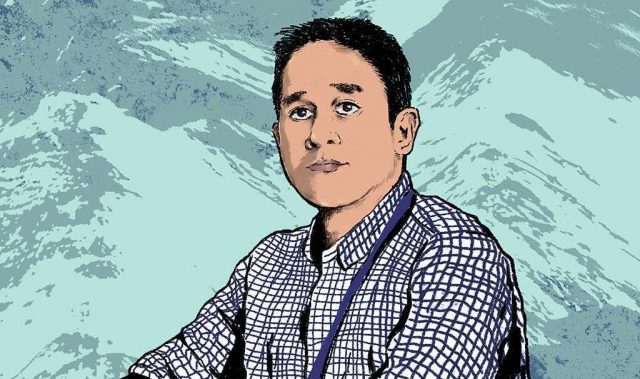
Suvrat Raju
Associate Professor
International Centre for Theoretical Sciences
India

AsianScientist (Aug. 14, 2020) – For researchers and space enthusiasts alike, black holes are perhaps the ultimate scientific mystery. With a gravitational pull so strong that not even light can escape, the impenetrable depths of black holes have long been an object of fascination—and intense academic research.
Associate Professor Suvrat Raju from the International Centre for Theoretical Sciences in Bengaluru, India, is one such scientist hoping to unlock the many mysteries of black holes. A fundamental tenet in physics holds that information can neither be created nor destroyed. Except, apparently, in black holes.
In 1975, Stephen Hawking discovered that over time, black holes would evaporate until there was nothing left. As the black hole disappears, in theory, so does the information stored within—seemingly breaking one of physics’ most inviolable laws. This conundrum is known as the black hole information paradox, and for the past four decades, researchers like Raju have been working to solve it.
For shedding new light into the black hole information paradox, Raju won the 2019 International Centre for Theoretical Physics Prize, an annual award that recognizes young physicists from developing countries. Speaking to Asian Scientist Magazine, he gives a preview of his life as a researcher and reveals his thoughts regarding issues beyond the realm of theoretical physics.
- How would you summarize your research in a tweet?
I mainly work on quantum aspects of gravity, which often involve theoretical investigations of the properties of black holes. But some of my work tackles completely different topics, including questions of nuclear energy, peace and disarmament, and civil rights.
- Describe a completed research project that you are proudest of.
I found in collaboration with Kyriakos Papadodimas from the International Centre for Theoretical Physics in Trieste, Italy, that in gravity, information is localized in a very unusual manner. For instance, the information inside a region can be simultaneously available outside that region, albeit in a scrambled form. These effects are very interesting since they give us such a new perspective on quantum information.
On the practical end, though, the work I did with M. V. Ramana of Canada’s University of British Columbia on the economic and legal aspects of nuclear energy may have a greater practical impact. We showed that the electricity from reactors that the Indian government was planning to import would have been much more expensive than electricity from competing sources, and that the legal framework put in place to enable these imports was flawed. Our work had an impact on the public debate. I am glad that we contributed to a process that has helped the country avert a significant amount of wasteful expenditure.
- What do you hope to accomplish with your research in the next decade?
I hope that we can move towards understanding more realistic aspects of quantum gravity. One deeper question our work touches on is how quantum mechanics works in a cosmological setting. Quantum mechanics was developed to understand laboratory systems, where there is a clear distinction between the observer and the system. But when studying the universe, there is no such distinction because the observer is necessarily part of the system. A consideration of quantum gravity forces us to confront this question and gives hints about the way forward.
- Who (or what) motivated you to go into your field of study?
My parents are academics, and I grew up in a university setting. So I never seriously thought about a life outside academia. My father had an important role in inculcating my interests in maths, physics and computers, while my mother is responsible for developing my interests in public-policy issues and activism.
- What is the biggest adversity that you experienced in your research?
I have been very privileged, and I can’t point to too many adversities. Perhaps one institutional issue that affects me is that India separated its scientific research institutes from universities. Such institutes have good scientific infrastructure but they lack some of the broader vibrancy of a university. So I sometimes miss being part of a university atmosphere.
- What are the biggest challenges facing the academic research community today, and how can we fix them?
In India, the biggest challenge is the tremendous inequity in the distribution of resources in our educational system and the broader society. Most students in India do not get a chance to develop to their potential because they lack access to basic educational resources. Millions of promising potential researchers never make it to the research community.
More resources should be devoted to education and distributed more equitably. But this kind of reform can only succeed as part of a broader movement for equity and justice in the country.
- If you had not become a scientist, what would you have become instead?
I would have been a full-time activist working on peoples’ issues. But, even then, I would have been good at doing analysis and supportive intellectual work for movements on the ground.
- What do you do outside of work to relax? Do you have any interests and hobbies?
I like running. I used to run middle distance at school. As I’ve grown older, I’ve started running slower but longer! And my older son has gotten me interested in chess. I used to think that the game was boring, but now I have started to study it.
- If you had the power and resources to eradicate any world problem using your research, which one would you solve?
My research in quantum gravity is very theoretical. As for real world problems, my firm belief is that most problems are not technical but have more to do with systemic issues of policy and power-inequity. If I could, I would like to contribute to building a society that is more equitable and just, both at a domestic and an international level.
- What advice would you give to aspiring researchers in Asia?
I think it is quite important for Asia to lead in scientific disciplines, and not just follow the prevalent fashions in the West. Our scientific administrators tend to look upon approval from Western academics as the sole criterion for whether work is good or not. But for most of human history, Asia has led the world in science and technology. I hope that we will be back in that position soon.

This article is from a monthly series called Asia’s Rising Scientists. Click here to read other articles in the series.
———
Copyright: Asian Scientist Magazine; Photo: Suvrat Raju.
Disclaimer: This article does not necessarily reflect the views of AsianScientist or its staff.