AsianScientist (Mar. 10, 2020) – If you need medical attention after midnight, chances are you’d have to pay a visit to the accident and emergency department at a hospital. If you are an elderly person with limited physical mobility, you may have some difficulty leaving your home to get medicine for, say, a sore throat.
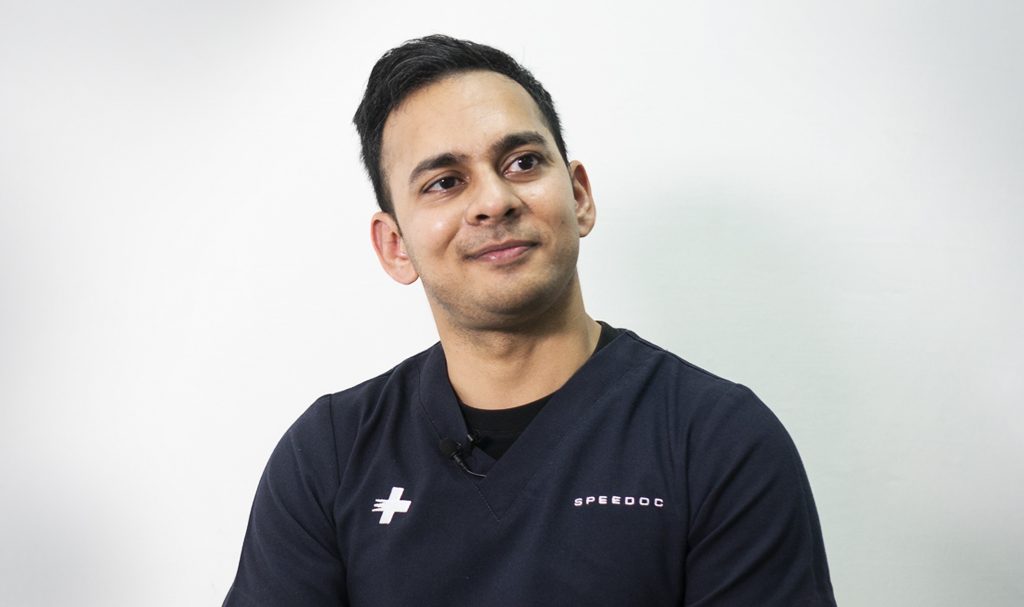
In these situations, wouldn’t it be better if you could summon a doctor or nurse to your doorstep to administer medical care? This is now possible with digital platforms that connect patients to healthcare practitioners at the touch of a button. Dr. Shravan Verma, founder and CEO of digital health company Speedoc, is already ‘shifting advanced medical care from hospital to home’ with its eponymous app.
“Speedoc provides services similar to that of a clinic, which includes medical consultation, medication dispensing, and sometimes, even more complex procedures like suturing, IV drips and mobile ultrasound,” Verma said.
Practicing medicine at various public hospitals after graduating from Duke-National University of Singapore Medical School, Verma noticed a deluge of patients visiting hospitals and having to wait several hours before getting to see a doctor.
“Many patients were also coming in for conditions that aren’t really life-threatening or critical, which means that they could actually be treated within their communities,” he explained.
Since Singapore has a relatively decentralized clinic system with many healthcare professionals located all across the island, Verma wanted to empower those healthcare workers to attend to patients in their vicinity. Speedoc thus emerged as something equivalent to the ‘Grab’ for healthcare.
Getting Speedoc to work was not without its challenges. Foremost among them: confronting misconceptions about the house call doctor system.
“One of the misconceptions that we’ve heard is that the house call doctor service is an old and an outdated concept,” Verma said. “However, when we use technology to support the service and make it more efficient, it’s really useful for bringing medical care out into the community and into people’s homes.”
Working with clinics and hospitals, Verma has managed to convince more than 50 doctors to come on board his platform, seeing some 30 patients a day. Verma noted that many organizations and institutions refer Speedoc to their patients for follow up care after those patients have been discharged.
Speedoc’s model became even more relevant as COVID-19 infections started to appear in Singapore.
“With the ongoing COVID-19 situation where people are hesitant to go to a clinic or a hospital for fear of spreading or catching the virus, having medical care delivered to them at home is very valuable. Ever since the coronavirus outbreak, we’ve definitely seen a high demand for our services. It’s almost doubled from what it was previously,” Verma highlighted.
Given the increased workload due to COVID-19, Verma himself is on the frontlines of delivering healthcare to the community. He recalls an incident where he was summoned via Speedoc to see a patient who just returned after extensive travel across the region and was exhibiting symptoms similar to that of COVID-19.
“We had to call the Ministry of Health surveillance officer as well as the ambulance to properly escort him to the hospital. I also had to self-quarantine myself until the patient’s test results came back. Thankfully, that patient tested negative for the coronavirus, so my quarantine lasted only two days,” Verma shared.
Verma also has plans to expand the number of possible functions on Speedoc. His team is currently building out the digital architecture for synchronizing data from medical devices, such as a blood pressure machine or an oximeter, with the Speedoc platform. When completed, it will allow doctors to monitor patients remotely and dispatch the appropriate medical service.
“What we’re doing is creating new touch points for people to be able to access healthcare services,” Verma concluded.
———
Copyright: Asian Scientist Magazine.
Disclaimer: This article does not necessarily reflect the views of AsianScientist or its staff.